Abstract
Objective: To examine the impact of El Salvador’s unprecedented mass incarceration policy on crime. Methods: The identification strategy of this paper exploits the launch of the incarceration policy in El Salvador, which increased the country’s prison population by 150% in just one year, propelling it to the top of global incarceration rankings. The methodology consists of fixed-effects models. Data for homicides comes from the National Civil Police, while data for other crimes comes from El Salvador’s Multipurpose Household Survey . Results: El Salvador’s unprecedented mass incarceration policy reduced homicides by 42%. Further, evidence suggests that the policy reduced street robberies by 20% and rapes by 62%, but had no measurable impact on assault, larceny , or motor vehicle theft.
Miguel Angel Santos * Adan Silverio-Murillo † Jose Balmori-de-la-Miyar ‡ Abel Rodríguez §
Abstract Objective: To examine the impact of El Salvador’s unprecedented mass incarceration policy on crime. Methods: The identification strategy of this paper exploits the launch of the incarceration policy in El Salvador, which increased the country’s prison population by 150% in just one year, propelling it to the top of global incarceration rankings. The methodology consists of fixed-effects models. Data for homicides comes from the National Civil Police, while data for other crimes comes from El Salvador’s Multipurpose Household Survey. Results: El Salvador’s unprecedented mass incarceration policy reduced homicides by 42%. Further, evidence suggests that the policy reduced street robberies by 20% and rapes by 62%, but had no measurable impact on assault, larceny, or motor vehicle theft. Conclusion: These findings contribute to the ongoing debate on the selective effectiveness of punitive criminal justice strategies. The results suggest that the observed reduction in crime following the policy is primarily driven by incapacitation rather than deterrence.
Keywords: El Salvador, Incarceration, Drug markets, Violence, Homicides, Crime.
JEL: K14, K42,
1 Introduction
Incarceration is one of the most debated tools in modern crime control. Several authors have found that incarceration can reduce crime through deterrence and incapacitation ( Levitt , 1996 ; Raphael and Johnson , 2010 ; Spelman , 2020 ). However, other studies challenge these findings, arguing that the effects of imprisonment are small or nonexistent, as new offenders often replace those who are jailed, with minimal overall impact on crime rates ( Kovandzic and Vieraitis , 2006 ; Stemen , 2007 ).
Most of the evidence on this topic comes from studies in high-income countries, particularly the United States and Italy. Still, we know little about how these policies affect developing nations like El Salvador. In March 2022, El Salvador launched a mass incarceration policy aimed primarily at gang members to reduce homicides. This policy dramatically increased the prison population from 40,000 to 100,000—a 150% increase in a single year ( Fair and Wlamsley , 2024 ).
We analyze the effects of El Salvador’s incarceration policy across six crime categories commonly used in the literature to evaluate such interventions: three personal crimes (homicide, assault, and rape) and three property crimes (street robbery, motor vehicle theft, and larceny). Our analysis relies on two primary data sources: administrative records from the National Civil Police and El Salvador’s Multipurpose Household Survey (MPHS), which captures victimization experiences at the household level.
First, we analyze the effect of the incarceration policy on homicides. Using a fixedeffects model, our results show that the policy reduced homicide rates by 42%. Second, we examine whether the policy had any external effects on other types of crime, specifically: assault, rape, street robbery, motor vehicle theft, and larceny. Fixed-effects models show that the incarceration policy reduced street robbery by 20% and rape by 62%. These findings are robust to a range of alternative specifications, including: (a) a bounding approach to assess sensitivity to potential omitted variable bias, (b) the use of wild-cluster bootstrap standard errors, and (c) changes in functional form.
This paper makes three important contributions to the literature on the effects of incarceration on crime. First, we offer empirical evidence that supports a middle ground between two competing hypotheses regarding the impact of mass incarceration ( Kovandzic and Vieraitis , 2006 ; Raphael and Johnson , 2010 ). Our results suggest that punitive incarceration policies can have substantial, yet selective, impacts. Specifically, we find significant reductions in high-social-cost crimes—such as homicides and rape—but no measurable effect on other offenses, including assault and larceny. Second, the vast majority of research on this topic has focused on high-income countries like Italy and United States ( Buonanno and Raphael , 2013 ; Kovandzic and Vieraitis , 2006 ; Levitt , 1996 ; Raphael and Johnson , 2010 ). By focusing on El Salvador, our study addresses a major gap in the existing literature, providing evidence from a developing nation. Finally, to the best of our knowledge, this is the first study to document the effects of an unexpected and large-scale incarceration campaign. El Salvador’s policy, which resulted in a 150% increase in the prison population over just nine months, represents a dramatic and sudden policy shock. Analyzing this unique event allows us to provide empirical evidence on the short-term impacts of extreme punitive measures, a type of intervention rarely observed or studied.
2 Does Incarceration Reduce Crime?
2.1 Theory: Incarceration and Crime
What is the relationship between incarceration and crime? On the one hand, incarceration may reduce crime trough incapacitation and deterrence mechanisms ( Raphael and Johnson , 2010 ). The incapacitation mechanism suggests that incarcerated criminals are unable to commit crimes. The deterrence mechanism indicates that incarceration deter potential criminal offenders from committing a crime.
Competing theories propose that incarceration has no effects on crime due to target and substitution mechanisms ( Kovandzic and Vieraitis , 2006 ). The target hypoth-
esis proposes that a small fraction of criminals commits the majority of crimes. Consequently, a mass incarceration policy may not effectively target the right offenders and thus fail to have the desired impact. The substitution hypothesis suggests that socioeconomic factors like poverty and unemployment can create a continuous supply of new offenders to replace those who are incarcerated, thereby mitigating the effects of incarceration policies.
Finally, the rational model of crime proposes that incarceration can increase or decrease crime ( Becker , 1968 ). In this model, criminals are viewed as rational individuals who weigh the benefits and costs of committing a crime. Incarceration policies rise the costs associated with crimes because it increases the probability of being incarcerated. Yet, incarceration policies also make people feel safer, which encourages them to take fewer security measures and increases the likelihood of crime. Thus, the effect of incarceration policies on crime may be ambiguous.
2.2 Empirical Evidence
The effects of incarceration on crimes are mixed. Levitt ( 1996 ), using data from the United States and an instrumental variable approach, finds that an increase of 1% in prison population decreases robbery by 0.70%, and burglary by 0.40%. However, there are no effects on larceny, motor vehicle theft, homicides, rape, and assault. Raphael and Johnson ( 2010 ), using a state-level panel data for the United States and an instrumental variables methodology, find that for each 1% increase in prison population, larceny decreased by 1.18%, burglary by 0.85%, and rape by 0.03%. Yet, these authors find no effects on robbery, motor vehicle theft, homicides, and assault. Finally, Kovandzic and Vieraitis ( 2006 ), using county panel data from Florida and fixed-effects models, find no evidence that an increase in prison population impacts crime rates such as homicide, rape, assault, robbery, burglary, and motor vehicle theft.
Other studies take advantage of decarceration’s impact on crime. Lofstrom and Raphael ( 2013 ), for example, exploit a sharp reduction in incarceration in California
and, using fixed-effects models, find no effects on homicides, rape, robbery, assault, burglary, and larceny. The only exception is vehicle theft, where findings suggests that each prison-year prevents 1.2 motor vehicle thefts. Also for the United States, Boylan ( 2025 ) analyzes court orders issued from 1970 to 1988 aimed at reducing jail overcrowding. The research found that while these orders achieved a 21%-reduction in jail populations, they were also associated with a 15%-increase in homicide rates outside of jails. In a different context, Buonanno and Raphael ( 2013 ) analyze a policy where the Italian government released more than one-third of the nation’s prison inmates in 2006. They examined ten crimes, including non-sexual violent crime, sexual assault, theft, robbery, extortion, kidnapping, arson, vandalism, drugs, and prostitution. Using a time series methodology, they only detected effects on theft and robbery.
In sum, the literature reveals three main points: (1) there are competing theories regarding the effects of incarceration on crime ( Kovandzic and Vieraitis , 2006 ; Raphael and Johnson , 2010 ); (2) empirical evidence shows that incarceration policies do not affect all crimes equally ( Levitt , 1996 ; Raphael and Johnson , 2010 ), and in some cases, no effects are observed on any crime ( Kovandzic and Vieraitis , 2006 ); and (3) the majority of evidence on incarceration has been examined in developed nations like the U.S.
and Italy ( Buonanno and Raphael , 2013 ; Kovandzic and Vieraitis , 2006 ; Levitt , 1996 ; Raphael and Johnson , 2010 ). This highlights that little is known about how this policy affects less developed countries.
3 The Context in El Salvador: Crisis and Response
For much of the early 21st century, El Salvador was known for having one of the highest homicide rates in the world. This security crisis was largely driven by the territorial expansion and violent operations of two major gangs, Mara Salvatrucha (MS-13) and Barrio 18. These groups originated from the deportation of gang-affiliated youth from the United States in the 1990s, and over time, they evolved into powerful criminal structures. They controlled neighborhoods, imposed illegal taxes through
extortion, and resisted law enforcement with organized force.
Both criminal groups operated in the United States and in the northern Central America triangles; namely, in El Salvador, Guatemala, and Honduras ( Wolf , 2012 ; Ruiz , 2025 ). Also, these groups are characterized for not having a clear leadership structure, but rather, a tight structure ( Wolf , 2012 ). Further, both groups tried different strategies of urban insurgency, employing ultra-violent methods to pursue their criminal activities ( Ruiz , 2025 ).
In June 2019, President Nayib Bukele took office and launched the Plan Control Territorial , a multi-phase public security strategy. The plan was designed to reclaim territory from criminal organizations and reassert state authority. It broadly included the deployment of police and military forces to high-crime urban areas and the disruption of gang communications within prisons. However, the plan’s full implementation was limited by fiscal restrictions imposed by opposition parties ( Maldonado , 2020 ).
These constraints may have undermined the effectiveness of the strategy, allowing gang structures and extortion practices to persist in many urban areas.
Homicide rates had already been on a downward trend in El Salvador since peaking at 100 per 100,000 inhabitants in 2015. By 2021, the homicide rate stood at 18 per 100,000. However, this relative calm was shattered in March 2022 when a series of unexpected events occurred. Specifically, the country experienced a sudden escalation in violence: 87 people were murdered over a three-day period, with 62 on March 26 alone—making it the deadliest day in El Salvador in over three decades. Authorities attributed the attacks to retaliation by the MS-13 gang. In response, on March 27, 2022, the Legislative Assembly approved Decree No. 333, declaring a State of Exception. This decree empowered security forces to deploy police and military in gang-controlled areas and make arrests without warrants ( Aleman , 2022 ).
This declaration marked the beginning of one of the most extensive internal security operations in recent Latin American history. Between March and July 2022 alone, authorities conducted over 45,000 arrests, more than doubling the pre-crackdown prison
population of 40,000. By December 2022, the incarcerated population had reached 100,000, representing a 150% increase in just ten months ( Urbina and Espinoza , 2023 ).
4 Did mass incarceration reduce homicides?
4.1 Data
To examine the effects of the mass incarceration policy on homicides, we use monthly data from the National Civil Police of El Salvador (NPC). The NPC collects monthly statistics on homicides and prisoners for the country’s 14 departments. Using this information, we generated homicide and incarceration monthly rates per 100,000 inhabitants. Our dataset covers four years, from 2019 to 2022, for all 14 departments.
However, we excluded 2020 from our analysis due to the COVID-19 pandemic. This gives us a final sample of 504 observations (14 departments x 12 months x 3 years).
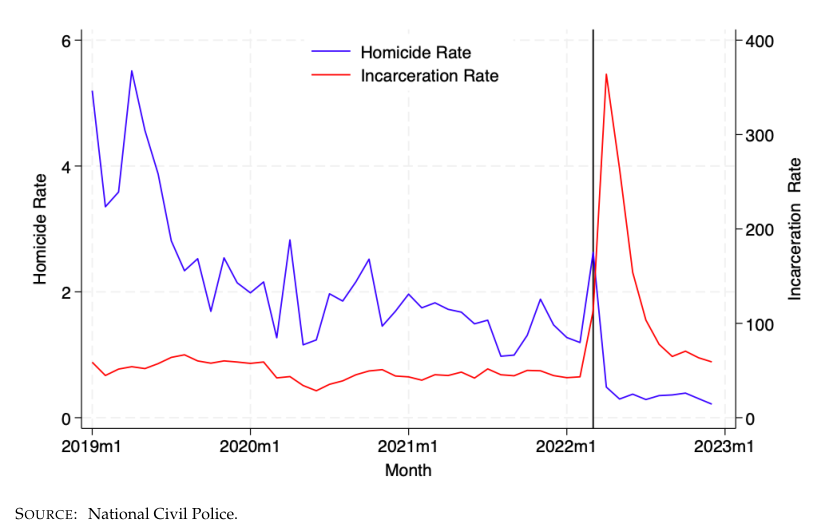
Figure I shows that the incarceration rate was stable from January 2019 to February 2022. It then began to increase sharply in March 2022, and returned to pre-policy levels by the end of the year. Table 1 presents descriptive statistics for homicide and incarceration rates before (January–February) and after (March–December) the mass incarceration policy in 2022. We observed that the average incarceration rate increased from 42 to 136 per 100,000 persons, while the average homicide rate decreased from 1.33 to 0.57 per 100,000 persons, a 57% reduction.
4.2 Empirical Strategy
The empirical strategy consists of a fixed-effects model:

where Hom dmy is the homicides rate for department d in month m and year y . Inc dmy
is the incarceration rate for department d in month m and year y . a d are departmentfixed effects, g m are month fixed-effects, and n y are year fixed effects. To consider population heterogeneity at the department level, the specification is weighted by the population at that level. We cluster standard errors at the department level. Finally, for some specifications, we include linear and exponential time trends to control for the observed fall in homicides prior to the implementation of the incarceration policy.
4.3 Main Results
The main findings are presented in Table 2 . Column (1) shows the results from the fixed-effects model without time trends. The nationwide results indicate that a oneunit increase in the incarceration rate translates into a 0.006 decrease in the homicide rate. As shown in Table 1 , the incarceration rate increased from 43 to 136 per 100,000 inhabitants—a increase of approximately 94. This implies that the incarceration policy reduced the homicide rate by 0.56 (0.006 x 94), or a 42% drop relative to the pre-policy homicide rate of 1.33 in January-February 2022.
Column (2) incorporates linear and exponential time trends into the fixed-effects model, to control for the observed fall in homicides prior to the implementation of the incarceration policy. In this specification, a one-unit increase in the incarceration rate is associated with a 0.005 reduction in the homicide rate. This suggests that the policy reduced the homicide rate by 0.47 (94 x 0.005), which represents a 35% drop compared to the pre-policy homicide rate.
Finally, Columns (3) and (4) present the results using a log-log model. The results remain statistically significant, suggesting that the detected effect is not sensitive to the functional form used. However, recent studies caution against using models with logarithms in the dependent variable, as they can introduce significant biases ( McConnell , 2024 ). Therefore, our preferred model remains the linear specifications presented in Columns (1) and (2).
4.4 Robustness Checks
To test the robustness of our findings, we conducted the following checks: a) utilizing Oster’s bounds to assess the results’ sensitivity to omitted variable bias, b) adjusting the standard errors using wild cluster bootstrap methods, c) examining the sensitivity of our results to the control years used, d) excluding the department of San Salvador to ensure our findings are not driven by an outlier, and e) re-estimating the model without population weights.
First, although the implementation of the incarceration policy was an unexpected shock, our fixed-effects methodology controls for time-invariant omitted variables.
However, our results could still be biased by omitted variables that change over time.
To check the sensitivity of our estimates to this issue, we employed the bounding methodology proposed by Oster ( 2017 ). This method generates a plausible range for the coefficient of interest. If this range does not include zero, the results are considered robust to omitted variable bias.
Table 3 Panel A presents the bounds estimated using Oster’s methodology for the
fixed-effects model, both without (Column 1) and with (Column 2) time trends. The bounds for Column (1) are [-0.0063, -0.0043], while the bounds for Column (2) are [- 0.0060, -0.0030]. In both cases, the bounds do not include zero, suggesting that our results are not sensitive to potential omitted variable bias.
Second, in our main specification, we clustered standard errors at the department level. However, given that we have fewer than 30 clusters, standard errors may be biased ( Cameron et al. , 2008 ). To address this potential issue, we use a wild cluster bootstrap process. Panel A, Columns (3) and (4) show the results using this method for the fixed-effects model, both without and with time trends. The 95% confidence interval for Column (3) is [-0.0072, -0.0038], and for Column (4) it is [-0.0067, -0.0024].
Since both intervals do not contain zero, the effects of incarceration on homicides remain statistically significant.
Third, we tested whether our results are sensitive to the choice of control year by using data from 2019 and 2021 separately. Panel B, Columns (1) and (2) show the fixed-effects models using only 2019 as the control group. Columns (3) and (4) show the models using only 2021. The results remain statistically significant regardless of the year used.
Fourth, we considered the possibility that our results might be driven by an outlier, specifically the Department of San Salvador. To address this concern, Panel C, Columns (1) and (2) show the fixed-effects models estimated with the San Salvador Department excluded. The findings continue to be statistically significant, confirming that our results are not exclusively driven by a single department.
Finally, we included population weights in our main analysis to account for differences in crime rates between departments with high and low populations. To ensure our results are not influenced by the use of these weights, we reproduced the main findings without them. Panel C, Columns (3) and (4) show that the coefficients for the effects of incarceration on homicides remain statistically significant, demonstrating that our findings are robust to this specification.
5 Did mass incarceration impact other crimes?
The main results suggest that targeting the incarceration policy toward gang members reduced homicide rates. The next question we examine is whether this policy had wider effects on other crimes. For example, by reducing the number of gang members on the streets, the number of rapes may also decrease. Similarly, non-gang-affiliated criminals, such as car thieves, might perceive an increased risk of arrest, which could deter them from committing crimes.
5.1 Data
To analyze the policy’s effect on other personal crimes (assault and rape) and property crimes (larceny, street robbery, and motor vehicle theft), we use data from the Multipurpose Household Survey (MPHS). We selected these crimes to allow for a direct comparison with existing literature ( Levitt , 1996 ; Lofstrom and Raphael , 2013 ; Kovandzic and Vieraitis , 2006 ; Raphael and Johnson , 2010 ). Since 2021, the MPHS has been representative across El Salvador’s 14 departments and is collected annually throughout the year ( Banco Central , 2023 ). We use data from the 2022 and 2023 MPHS. 1 The crime questions are structured to ask, “Did you or someone in your household suffer from (name of the crime) in the last 12 months?” This allows the 2022–2023 MPHS data to capture three distinct periods of exposure to the mass incarceration policy (see Table 4 ). First is the unaffected period , which includes survey data from January to March 2022. For example, a person interviewed in January 2022 would not have been exposed to the policy because the data refers to the January–December 2021 period, which precedes the policy’s start in March 2022.
The second is the partially affected period , with survey data conducted between April 2022 and February 2023. For example, a person interviewed in January 2023 would be partially affected, as the data aggregates information from January to December 2022, which includes ten months (March–December 2022) of policy exposure.
Last is the fully affected period , with data from surveys conducted from March to December 2023. For example, a person interviewed in May 2023 would have been fully exposed, as their information from May 2022 to April 2023 falls entirely within the policy’s duration.
Table 5 presents descriptive statistics for property crimes (larceny, street robbery
1 We do not use the 2021 MPHS because its reported data is affected by the COVID-19 pandemic. For example, the January data for the 2021 MPHS pertains to the January–December 2020 timeframe. Similarly, we exclude the 2020 MPHS as data was not collected for every month, particularly from April to June.
and motor vehicle theft) and personal crimes (assault and rape) across these three periods. Column 1 reports data from the unaffected period (January–March 2022 MPHS), Column 2 from the partially affected period (April 2022–February 2023 MPHS), and Column 3 from the fully affected period (March–December 2023 MPHS).
For street robbery, the probability of being robbed decreased from 2.75 in the unaffected period (Column 1) to 2.17 in the fully affected period (Column 3). This represents a 0.58-point drop, or a 21% decrease. Larceny and motor vehicle theft did not show a statistically significant change over the study period.
In the case of rape, the probability of experiencing rape decreased from 0.35 in the unaffected period (Column 1) to 0.19 in the fully affected period (Column 3). This is a 0.16-point drop, or a 45% decrease. Conversely, assault did not show a statistically significant change during the study period.
5.2 Empirical Strategy
We use a fixed-effects model, which regression appears as:

Where Y hdm is a dummy variable that takes the value of 1 if a member of the household h , in department d , and survey-month m reported being a victim of a particular crime (larceny, street robbery, motor vehicle theft, assault, and rape). Treatment (1) hdm is a dummy variable that equals one for months partially impacted by the incarceration policy (MPHS April 2022- MPHS February 2023). Treatment (2) hdm is a dummy variable that equals one for months completely impacted by the incarceration policy (MPHS March 2023- MPHS December 2023).
X hdm represents a series of control variables that may affect crime rates such as remittances, divorce, poverty, access to parks, and young people between the ages of 15 and 24 ( Kovandzic and Vieraitis , 2006 ). Remittances is a dichotomous variable that
takes the value of 1 if the household received remittances in the last twelve months.
Divorce is a dichotomous variable that takes the value of 1 if the head of the household reports being divorced. Poverty is a dichotomous variable that takes the value of 1 if the household income is less than the cost of the basic food basket ( Banco Central , 2023 ). Access to parks is a dichotomous variable that takes the value of 1 if there is a park or green area in the community. Finally, the variable age 15 to 24 takes the value of 1 if there is at least one person in that age group in the household.
Finally, a d and g m are department and survey-month fixed effects. The regression is weighted by the population at the department level, and we cluster standard errors at the department level. The parameters b 1 and b 2 are the estimators of interest.
5.3 Results
Table 6 presents our main results using a fixed-effects model. Columns 1 through
3 show the findings for property crimes: larceny, street robbery, and motor vehicle theft. For street robbery, the policy reduced the incidence of this crime by 0.0070 or 0.70% for individuals in the “fully affected” group (Treatment 2). This translates to a 20% reduction when compared to the pre-policy mean (0.70/3.38). Our analysis found no evidence that the incarceration policy had a measurable impact on larceny or motor vehicle theft.
Columns 4 and 5 show the results for the personal crimes of assault and rape. For rape, the incarceration policy reduced the crime by 0.20% for individuals in the “fully affected” group (Treatment 2). This implies a 62% reduction when compared to the pre-policy mean (0.20/0.32). The policy, however, did not have a significant impact on assault.
5.4 Robustness Checks
We conduct the following robustness checks to test the results: (1) using a bounding methodology to check the sensibility of the results to omitted variables, (2) adjusting standard errors using wild cluster bootstrap methods, (3) changing the functional form, (4) running the model without population weights, (5) excluding control variables, and (6) excluding the Department of San Salvador. The results are presented in the Appendix. The robustness checks confirm the incarceration policy decreased street robbery and rape.
6 Discussion
This study examines the impact of El Salvador’s unprecedented incarceration policy, introduced in March 2022, on personal and property crimes. Using fixed-effects models and data from the National Civil Police (NCP) and the Multipurpose Household Survey (MPHS), we find that the policy reduced homicides by 42%, rape by 62%, and street robbery by 20%. However, we find no effects on assault, larceny, or motor vehicle theft. Finally, the study also helps to clarify whether the recent decline in homicides reflects a continuation of a pre-existing downward trend or the effect of the policy itself. Our evidence shows that the reduction in homicides occurred in addition to the previous trend decline, indicating that the policy generated a substantial new reduction.
This paper builds on the existing literature by providing evidence consistent with previous findings in two key areas. First, our findings reinforce the evidence that incarceration policies have selective effects, reducing some crimes but not all. El Salvador’s case is uniquely relevant due to the policy’s unprecedented scale—a 150% prison population increase in ten months—and its context as a developing country.
Despite these distinctive features, the selective nature of our results mirrors findings from higher-income contexts ( Levitt , 1996 ; Raphael and Johnson , 2010 ). Second, we
provide evidence on the role of street gangs in crimes against women. Our results are consistent with existing studies ( Silverio-Murillo et al. , 2024 ), showing that the reduction in gang activity coincides with a decline in rape incidents.
Regarding the underlying mechanisms, the results suggest that the observed reduction in crime following the policy is primarily driven by incapacitation rather than deterrence. The declines in homicides, street robbery, and rape indicate that removing a large number of offenders from the streets was the main driver of the effect. Moreover, the absence of an impact on crimes that typically are not associated with gangs, such as larceny, provides little support for a deterrence mechanism. Nonetheless, a key limitation of this study is that the available data do not allow us to empirically distinguish between these mechanisms, highlighting the need for further research.
From a policy perspective, our findings reinforce the view that incarceration can be effective in reducing certain crimes but should not be expected to reduce all forms of criminal behavior. The selective nature of its effectiveness underscores the necessity of complementary strategies to address other social and economic drivers of crime.
Furthermore, policymakers must carefully weigh the policy’s benefits against its costs and risks. While the policy arguably increased public safety, there is a risk of incarcerating innocent individuals. For example, in the case of El Salvador, over 8,000 individuals have been released and reintegrated into their communities ( Suárez , 2025 ).
Finally, implementing El Salvador’s model elsewhere may face significant challenges, as its effectiveness relied on unique circumstances, particularly the ability to rapidly identify and detain gang members via visible markers like tattoos. This mechanism is not easily replicable in countries where organized crime groups use more covert methods, complicating efforts to swiftly dismantle criminal structures through such concentrated measures.
References
A LEMAN , M. (2022): “El Salvador aprueba prórroga del estado de excepción,” Los Angeles Times , https://www.latimes.com/espanol/internacional/articulo/2022-05- 26/el-salvador-aprueba-prorroga-del-estado-de-excepcion.
B ANCO C ENTRAL , D . R. (2023): “Encuesta de Hogares de Propósitos Múltiples,” Reporte del Banco Cebtral de Reserva , https://onec.bcr.gob.sv/estadisticassociales/encuesta-de-hogares-de-propositos-multiples/.
B ECKER , G. S. (1968): “Crime and punishment: An economic approach.” Journal of Political Economy , 76(2), 169–217.
B OYLAN , R. T. (2025): “How Court Mitigation of Jail Overcrowding Affects Homicides,” The Journal of Law and Economics , 68, 561–584.
B UONANNO , P. AND S. R APHAEL (2013): “Incarceration and Incapacitation: Evidence from the 2006 Italian Collective Pardon,” American Economic Review , 103, 2437–2465.
C AMERON , A. C., J. B. G ELBACH , AND D. L. M ILLER (2008): “Bootstrap-Based Improvements for Inference with Clustered Errors,” The Review of Economics and Statistics , 90, 414–427.
F AIR , H. AND R. W LAMSLEY (2024): “Worls Prison Population List,” World Prison Brief , 14.
K OVANDZIC , T. AND L. V IERAITIS (2006): “The effect of county-level prison population growth on crime rates,” Criminology & Public Policy , 5, 213 – 244.
L EVITT , S. (1996): “The Effect of Prison Population Size on Crime Rates: Evidence from Prison Overcrowding Litigation,” The Quarterly Journal of Economics , 111, 319–351.
L OFSTROM , M. AND S. R APHAEL (2013): “Incarceration and Crime: Evidence from California’s Public Safety Realignment Reform,” The Annals of the American Academy of Political and Social Science .
M ALDONADO , C. (2020): “Bukele se enfrenta al Parlamento de El Salvador y genera una crisis constitucional,” El País , https://elpais.com/internacional/2020/02/10/america/1581294344_999638.html.
M C C ONNELL , B. (2024): “Can’t See the Forest for the Logs: On the Perils of Using Difference-in-Differemces With a Log-Depndent Variable,” Working Paper , https://brendonmcconnell.github.io/pdf/logDD.pdf.
O STER , E. (2017): “Unobservable Selection and Coefficient Stability: Theory and Evidence,” Journal of Business & Economic Statistics , 0, 1–18.
R APHAEL , S. AND R. J OHNSON (2010): “How Much Crime Reduction Does the Marginal Prisoner Buy?” Journal of Law and Economics , 55.
R UIZ , P. (2025): “Mara Salvatrucha (MS-13) and Barrio 18: Gangs, Terrorists, or Political Manipulation?” Third Generation Gangs and Transnational Cartels: A Small Wars Journal–El Centro Anthology .
S ILVERIO -M URILLO , A., F. M ARQUEZ -P ADILLA , AND J. B ALMORI – DE – LA M IYAR (2024): “Earthquakes and Crimes Against Women,” Feminist Economics , 30, 1–27.
S PELMAN , W. (2020): The Limited Importance of Prison Expansion , 150–164.
S TEMEN , D. (2007): “Reconsidering Incarceration: : New Directions for Reducing Crime (Jan. 2007),” Federal Sentencing Reporter , 19, 221–233.
S UÁREZ , K. (2025): “El modelo Bukele tiene simpatizantes, pero replicarlo no es tan fácil,” CNN , https://cnnespanol.cnn.com/2025/04/24/latinoamerica/modelobukele-simpatizantes-replicarlo-no-facil-orix.
U RBINA , J. AND C. E SPINOZA (2023): “El Salvador llegó a 97 mil 525 reos en 2022,” La Prensa Gráfica , https://www.laprensagrafica.com/elsalvador/El-Salvador-llegoa-97-mil-525-reos-en-2022-20230116-0099.html.
W OLF , S. (2012): “Mara Salvatrucha: The most dangerous street gang in the Americas?” Latin American Politics and Society , 54, 65–99.
7 Figures and Tables
Figure I: Monthly Homicide and Incarceration Rates: 2019-2022
(1) (2) 2019–21 2022 Jan–Feb March–Dec Dif. Jan–Feb March–Dec Dif. Homicide Rate 3.01 2.39 -0.62** 1.33 0.57 -0.76*** Incarceration Rate 46.33 53.09 6.76*** 42.68 136.74 94.06*** Observations 336 168
Table 2: Difference-in-differences: Main Results of Police Records
Linear model Log-Log model (1) (2) (3) (4)
Incarceration Rate -0.006*** -0.005*** -0.179*** -0.187*** (0.001) (0.001) (0.053) (0.056)
R 2 0.61 0.61 0.69 0.69 Observations 504 504 504 504 Mean (Jan-Feb 2022) 1.33 1.33 D Homicide Rate= b x 94 ( D Inc. Rate) -0.56 -0.47 Percentage Change -42.40% -35.33% Baseline FE X X X X Time Trends X X
Table 3: Robustness Checks of Main results
Panel A: Omitted Variables and Standard Errors Oster’s bounds Wild Cluster (1) (2) (3) (4)
Incarceration Rate [-0.0063, -0.0043] [-0.0060, -0.0030] [-.0072, -.0038] [-.0067, -.0024] R 2 0.61 0.61 0.61 0.61 Observations 504 504 504 504 Baseline FE X X X X Time Trends X X Panel B: Different control groups Control: 2019 Control: 2021 (1) (2) (3) (4)
Incarceration Rate -0.008*** -0.008*** -0.002*** -0.003*** (0.001) (0.001) (0.001) (0.001)
R 2 0.70 0.70 0.51 0.55 Observations 336 336 336 336 Baseline FE X X X X Time Trends X X Panel C: Outliers and Population Weights Without Population Without San Salvador Department Weights (1) (2) (3) (4)
Incarceration Rate -0.005*** -0.004*** -0.004*** -0.004*** (0.001) (0.001) (0.001) (0.001)
R 2 0.55 0.56 0.56 0.57 Observations 468 468 504 504 Baseline FE X X X X Time Trends X X S OURCE : National Civil Police. N OTES : Baseline fixed effects are included at the department, month, and year. Robust standard errors are clustered at the department level. Significance levels: * p < 0.1, ** p < 0.05, *** p < 0.01. The specification is weighted by the department-level population. Panel A Columns (1) and (2) present the sensitivity of the results to omitted variables using a bounding methodology (Oster, 2017). Panel A Columns (3) and (4) estimate the main results using wild cluster standard errors. Panel B Columns (1) and (2) use as a control group only data for 2019. Panel B Columns (3) and (4) use as a control group only data for 2021. Panel C Columns (1) and (2) estimate the main results without the San Salvador Department. Panel C Columns (3) and (4) estimate the main results without population weights.
Table 4: Survey Data Collection and Incarceration Policy Impact Analysis
Table 5: Descriptive Statistics of Survey Records
Table 6: Fixed-Effects: Main Results of Survey Records
Appendix
To test the robustness of the results regarding street robbery and rape, the following robustness checks are conducted: (1) using a bounding methodology to check the sensibility of the results to omitted variables, (2) adjusting standard errors using wild cluster bootstrap methods, (3) changing the functional form, (4) running the model without population weights, (5) excluding control variables, and (6) excluding San Salvador department.
First, we analyze the sensibility of the results to omitted variable bias using the bounding methodology proposed by Oster ( 2017 ). Table A1 Panel A presents the bounds estimated using the Oster’s methodology. The bound for Treatment 2 regarding street robbery is [-0.009, -0.006], and the bound for Treatment 2 regarding rape is [-0.005, -0.001]. Thus, Oster’s bounds suggest that the results regarding street robbery and rape are not sensible to omitted variable bias.
Second, we cluster the standard errors using a wild cluster bootstrap process ( Cameron et al. , 2008 ). Table A1 Panel B shows the results using this methodology.
The original p-values are presented in parenthesis, and the corrected p-values using wild cluster standard errors are presented in brackets. It is observed that the effects of incarceration on street robbery and rape continue being statistically significant for Treatment 2 (the period fully affected by the policy).
Third, it could be the case that the results are driven by using a linear-linear model. Thus, we estimate the main results using a logit model. Table A1 Panel C presents the results. The findings regarding street robbery and rape continue being statistically significant. In other words, the results regarding street robbery and rape are not sensible to the functional form implemented.
Fourth, we include population weights in our main results. Yet, it is possible that the results observed are influenced by the use of population weights. Table A2 Panel A reproduces the main results excluding population weights. It is observed that the
coefficients regarding the effects of incarceration on street robbery and rape continue being statistically significant.
Fifth, the main results include control variables like poverty, youth, and remittances that can affect crime. On the one hand, one might expect that since the incarceration policy was implemented in an unexpected manner, the inclusion of control variables would have no impact on the estimated coefficients. On the other hand, it is possible that the inclusion of control variables would change the direction and magnitude of the estimated coefficients. Table A2 Panel B shows the main results excluding control variables. We observe that the results regarding street robbery and rape remain robust after excluding such control variables.
Sixth, we considered the possibility that our results might be driven by the Department of San Salvador. To address this concern, Table A2 Panel C shows the resuls with the San Salvador Department excluded. The findings regarding street robbery and rape continue to be statistically significant, confirming that our results are not exclusively driven by a single department.
Table A1: Robustness Checks I: Survey Records
Table A2: Robustness Checks II: Survey Records