Transcripción completa del PDF reformateada para lectura web. Descargar PDF original para tablas, figuras y referencias.
Copyright 2017 Hausmann, Ricardo; Santos, Miguel Angel; Obach, Juan; and the President and Fellows of Harvard College

1 | Appraising the economic potential of Panama: Policy recommendations for sustainable and inclusive growth.
Introduction
“ Once we regain the sovereignty over the Canal, our exports will grow faster. If we cannot increase the toll rates, we will have to develop along the shores of the Canal. ” Those were the of words Omar Torrijos to writer Graham Greene in 1978 1 , less than a year after the signature of the Torrijos-Carter Treaty that mandated the United States’ withdrawal from the Canal on the first day of the year 2000. The Panamanian General, who died in a controversial airplane accident in 1981, never imagined the prophetic power of his statements.
For more than a decade, Panama has been among the fastest-growing economies in the world. A few years after gaining full sovereignty over the Canal, Panama initiated a long spell of accelerated growth that doubled its income per capita. As foreseen by Torrijos, growth has been fueled by the development of a modern exportable service sector along the shores of the Canal. Ports, logistics and communication facilities, business services, wholesale and retail trade, and a vibrant air hub have blossomed. These activities, in turn, have stimulated demand for non-residential construction. Large public infrastructure investments such as the expansion of the Canal, the development of the Metro in Panama City, Tocumen Airport, road expansions and upgrades in the Panama-Colón axis have all boosted an extraordinary construction boom.
For more than a decade, non-residential construction has been growing at a compounded annual growth rate (CAGR) of more than 20%. That is roughly equivalent to doubling the stock of structures in the country every four years. Between 2005 and 2015, non-residential construction tripled its share within the Panamanian gross domestic product (from 6.6% to 17.0%). Compounded with the residential component (8.6%), construction today represents an astounding 25.6% of Panama’s gross domestic product (GDP).
The construction boom has been the main driver behind the drastic reduction registered in poverty rates and inequality. It created a vibrant labor market for non-skilled workers, squeezing labor out of low-productivity agriculture. As workers migrated from rural areas and plugged into urban construction sites, average productivity and salaries increased.
But non-residential construction cannot grow at a higher rate than the rest of the economy indefinitely. Eventually, the stock of structures required by the booming service sector will be in place, and the pace will slow down. Indeed, early indicators such as value and number of residential and non-residential construction permits, and quantity of cement or ready-mix concrete produced, are already signaling a significant deceleration. This will threaten some of the progress achieved in the reduction of poverty and inequality, an issue of concern for a country that remains among the most unequal in the world, despite its recent economic achievements.
Within that context, it is essential to identify some sectors that can carry the torch for a sustained demand for construction, albeit at a lower rhythm, and iteratively solve the most binding constraints to their development. Those sectors would also provide the foreign currency Panama needs to purchase the products it does not manufacture, while reducing the persistent current account deficit without further growth deceleration.
4 | Appraising the economic potential of Panama: Policy recommendations for sustainable and inclusive growth.
Efforts to promote export diversification should move along two different tracks. On the one hand, there is scope to continue developing the modern service sector. As much as Panama has grown and improved, there are still gaps in terms of infrastructure and logistic performance when compared to other countries based on similar service models such as the Netherlands, Singapore and Hong-Kong. These activities are highly sophisticated and require skills that are not abundant in Panama. In recent years, school enrollment improved significantly, and completion rates at all levels have increased as well. In terms of quality, much remains to be done. Investing in improving the quality of education is a necessary condition to make growth more inclusive, but in the meantime Panama cannot afford to wait. Attracting and retaining the skilled-labor required by the service sector to continue growing, and maximizing its spillovers to the rest of the economy, are the keystones to sustainable growth and competitiveness.
The second track of the strategy relates to the productive diversification of the Panamanian provinces. At present, most of the provinces are lagging behind Panama City and Colón, which concentrate 80% of economic activity and 59% of the population. It is essential to recognize that not all provinces are made equal, and therefore the role of the State in solving coordination problems and spurring diversification will differ in nature depending on the place. Likewise, not all economic activities are equally likely in all places. An effort needs to be made in order to detect productive capabilities in each of the provinces and, based on that stock of knowledge, identify more complex “adjacent” activities that could be developed by redeploying those skills. Once the potential industries are identified, an iterative process must follow, in order to pinpoint and solve the most binding constraints to their appearance and expansion. In this process, the role of public-private dialogue is essential.
These are not the only challenges Panama faces, but they are certainly the most significant. Some other constraints that are not evident at the national level, such as energy supply, might be binding at the province level. Institutional development is another area where Panama is lagging behind other countries with similar income. That manifests in phenomena like excessive and inefficient red tape and corruption. Policy efforts in these areas must be undertaken, but results will be slow in coming. In the meantime, Panama must think in terms of policies to be implemented by the institutions it already has in place – which have already taken Panama a long way – not the institutions it wishes it had.
This document summarizes the work the Center for International Development of Harvard University has been carrying out to help Panama rethink its development strategy, under the sponsorship of the Inter-American Development Bank. We start by characterizing the growth trajectory of Panama (Section 1), and the structural transformation that has taken since Panama gained full sovereignty over the Canal (Section 2). Next, we identify the most binding constraints to economic growth that have resulted from our Growth Diagnostic (Section 3), and summarize policy recommendations required to start shifting gears and continue growing at a sustainable and more equitable pace (Section 4). In Section 5 we provide a roadmap of the most attractive opportunities for productive diversification at the national and sub-national level, and exemplify the particular cases of Chiriqui and Darien.
5 | Appraising the economic potential of Panama: Policy recommendations for sustainable and inclusive growth.
1. The growth trajectory of Panama
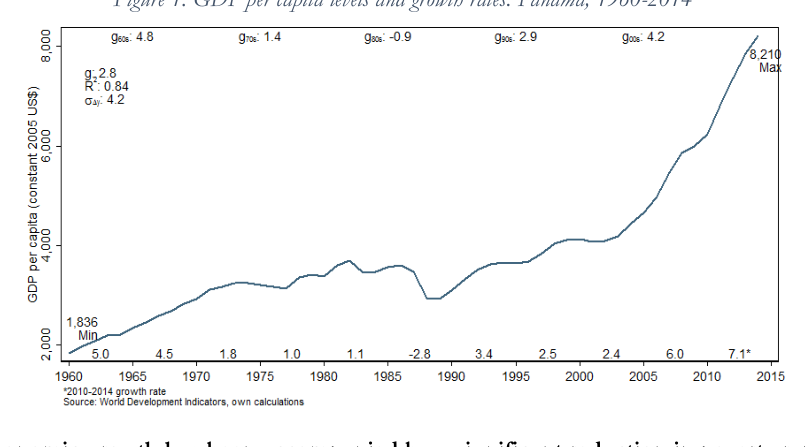
Panama has been displaying one of the fastest growth accelerations in the world . A few years after gaining full sovereignty over the Canal, the country began a rapid economic expansion (Figure 1), that is still ongoing today. Income per capita grew at a solid 6.2% compounded annual growth rate (CAGR) between 2005 and 2015, making Panama the leader among Latin American countries, at a significant distance from the other top performers, Uruguay (5.0%) and Peru (4.7%). Even in the aftermath of the commodity-boom that slowed down economic activity in the region, Panama is expected to remain strong, having grown at 4.8% in 2016 2 . By 2015, the country had almost doubled (82.4%) its 2005 income per capita, reaching US $22,192 at purchasing-parity levels 3 .
Figure 1. GDP per capita levels and growth rates: Panama, 1960-2014
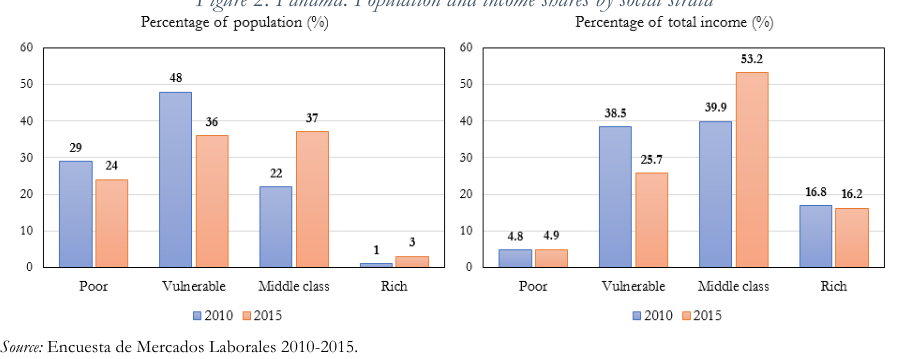
Fast economic growth has been accompanied by a significant reduction in poverty rates and a substantial expansion of the middle class (Figure 2). The reduction in poverty was driven by a combination of massive job creation for unskilled workers in urban areas, and a strong program of conditional cash transfers to households in rural areas. Most of these jobs have been created by the construction sector, which has absorbed labor released by low-productivity agriculture. Over the span of five years, the middle class went from being 22% of the population and earning 40% of income, to representing 37% of the population and earning 53% of income. Rich persons in Panama increased from 1 to 3 percent of the population, but their share of income decreased slightly (16.8% in 2010 vs. 16.2% in 2015). 4 6 | Appraising the economic potential of Panama: Policy recommendations for sustainable and inclusive growth.
Figure 2. Panama: Population and income shares by social strata
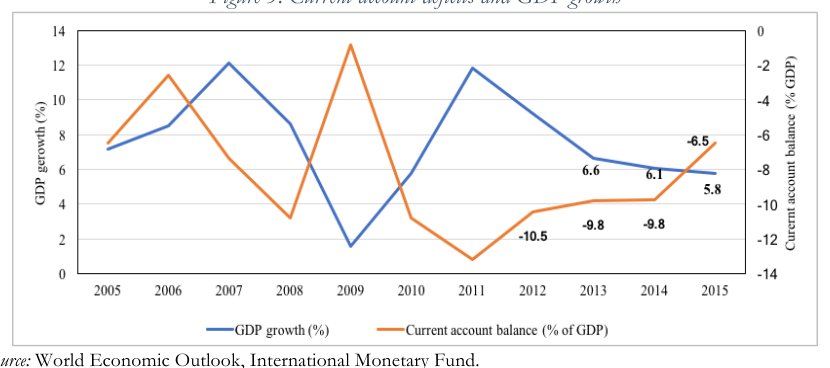
Fast economic growth has also been accompanied by significant current account deficits (Figure 3). The only exception was the year 2009, when the liquidity crunch caused by the world financial crisis brought capital inflows to a halt, forcing Panama to eliminate its external deficit of 10.8% (2008). One of the drivers of the current account balance achieved in 2009 (-0.6% of GDP) was a 12% import reduction, which in turn resulted in lower growth (4.1%, down from 9.7% in 2008). Since then, Panama has been struggling with large current account deficits averaging 10.1% of GDP (2010-2015). Attempts to curb these deficits have been accompanied by lower growth rates.
Figure 3. Current account deficits and GDP growth
Source: World Economic Outlook, International Monetary Fund.
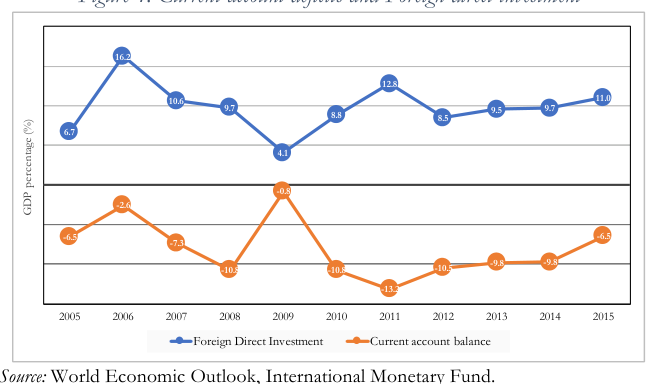
Current account deficits have been financed via massive inflows of foreign direct investment (FDI) (Figure 4). Over the 2005-2015 decade, Panama received an average of US $3.0 billion per year in FDI, equivalent to 9% of GDP. For 2016, the World Bank estimates an FDI inflow totaling 11% of GDP, placing Panama well ahead of Chile (8.5%), Nicaragua (6.5%), Brazil and Colombia (both at 4.0%), as the top destination for FDI in the region.
7 | Appraising the economic potential of Panama: Policy recommendations for sustainable and inclusive growth.
Figure 4. Current account deficits and Foreign direct investment
Source: World Economic Outlook, International Monetary Fund.
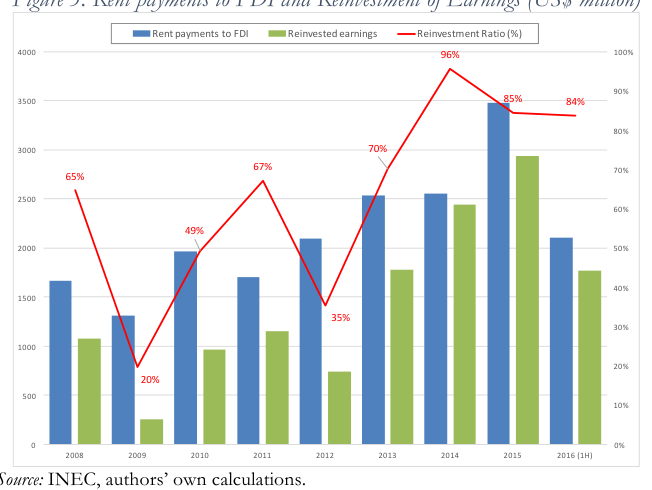
FDI seems to have some elements of sustainability, as the rents earned by multinational corporations tend to be reinvested in Panama (Figure 5). Between 2013 and 2016, reinvestment ratios averaged 84%. The figure had remained consistently above 65% for every year of the previous decade, except for 2009 (20%) and 2012 (35%).
Figure 5. Rent payments to FDI and Reinvestment of Earnings (US$ million)
Source: INEC, authors’ own calculations.
8 | Appraising the economic potential of Panama: Policy recommendations for sustainable and inclusive growth.
2. Structural transformation
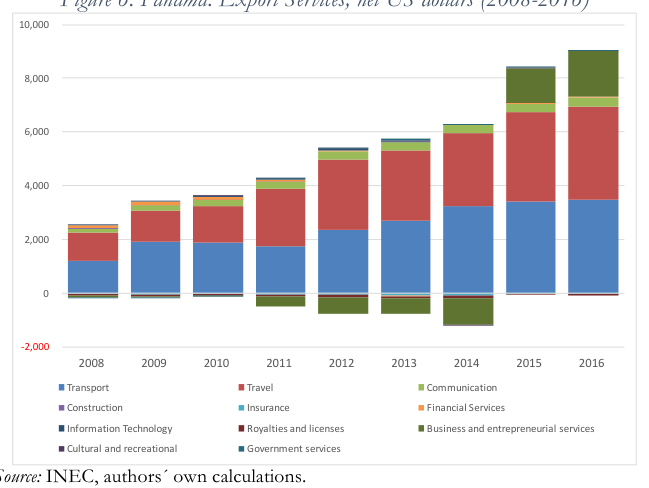
Panama’s impressive growth can be attributed to three main engines: exportable services, construction and commercial activity at Colón Free Zone. The bulk of FDI entering Panama goes to the exportable service sector (83%), with only minor shares going to non-exportable services (12%) and tradable goods (5%). Spurred by foreign investment, Panama quadrupled its service exports over the span of eight years (2008-2016), providing a steady flow of foreign currency that mitigated its trade deficit. Panama has become the largest per capita exporter of services in Latin America, ahead of its closest runners-up, Uruguay and Dominican Republic, by a factor of three, and coming very close to OECD levels. This stands in sharp contrast to Panama’s ranking in per capita exports of goods, where it lies at the bottom of Latin America with a negligible figure.
Export services are dominated by transportation (including the Canal) and travel, each accounting for 39% of total export services . They are followed at a distance by business services (18%) and financial intermediation (4%). 5
Figure 6. Panama: Export Services, net US dollars (2008-2016)
Source: INEC, authors ́ own calculations.
These services, together with wholesale and retail trade, have provided much of the momentum for the economy, and have boosted demand for non-residential construction. Ports, logistics and communication centers, warehouses, office buildings, wholesale and retail facilities, the 5 Starting in 2012, INEC introduced a change in the way they account for re-exports of goods (and oil in particular). Before 2012, INEC used to report only the net margin left by these operations, in the balance of payments. From 2012 onwards, they started recording these as imports (negative) in the balance of goods (under the heading “ Goods acquired in ports by means of transportation ”); and simultaneously record an export (positive) in the balance of services (“ Other business and entrepreneurial services ”). In order to ease the 2008-2016 comparisons and avoid misrepresentations, in Figure 6 we netted these amounts, as it was done before 2012, and reported the net balance as a service export. Note that the net balance of US$1.292 million registered in 2015 and US$ 1.708 million forecasted for 2016, are already net of imports of “ Goods acquired in ports by means of transportatio n”.
9 | Appraising the economic potential of Panama: Policy recommendations for sustainable and inclusive growth.
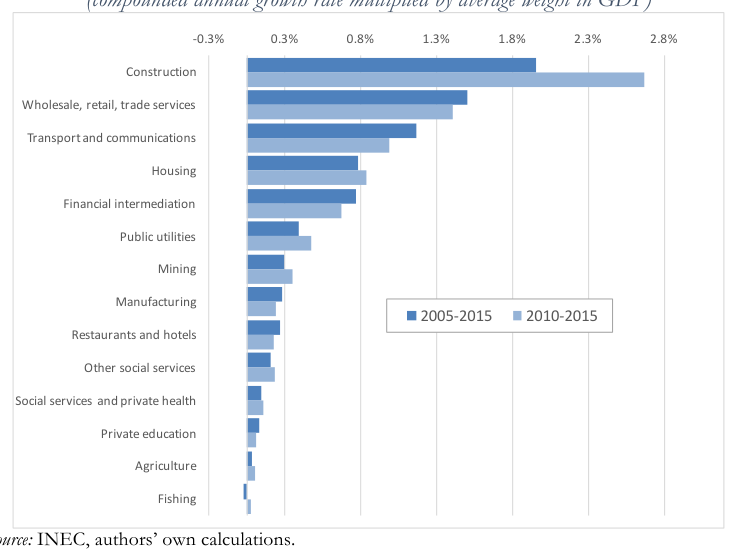
expansion of the Canal, the construction of the Metro in Panama City, and Tocumen Airport have all fueled a remarkable construction boom. Over the previous decade, non-residential construction grew at a compounded annual growth rate (CAGR) of more than 20%. That is equivalent to doubling the stock of structures every four years. Between 2005-2015, non-residential construction almost tripled its share within Panamanian GDP (from 6.6% to 17.0%), and accounted for more than a quarter (26%) of all growth registered during that decade, one-third of all growth registered between 2010-2015 (Figure 7). If we consider also the residential component, construction delivered 36% of all growth achieved between 2005-2015, 44% of all growth registered between 2010-2015.
Figure 7: Panama: Contribution to growth by sector 2005-2015 (compounded annual growth rate multiplied by average weight in GDP)
Source: INEC, authors’ own calculations.
The third engine of growth has been commercial activity at the Colón Free Zone (CFZ), the most important import-export zone of the Americas and second largest worldwide. 6 Total net value added (exports-imports) at CFZ quadrupled between 2000 and 2012, going from US$3 to US$12 billion, mostly driven by channeling the traffic of goods coming from Asia (72% of total imports) to Central America and the Caribbean (82% of total exports). Since 2014, however, this engine has lost traction, mostly due to the deterioration of the Venezuelan economy (third main export destination), and new import-taxes charges on clothes and shoes by Colombia (second largest export destination). 7 10 | Appraising the economic potential of Panama: Policy recommendations for sustainable and inclusive growth.
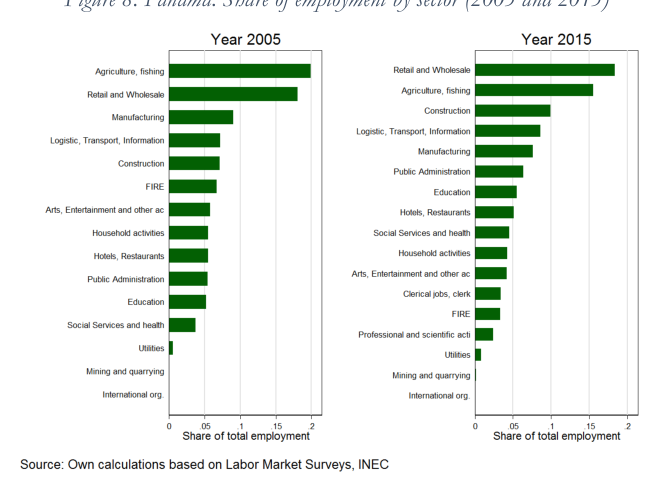
Changes in GDP composition between 2005 and 2015 have been accompanied by large changes in the structure of employment (Figure 8). During this decade, three sectors experienced the largest increases in the share of employment: construction; logistics, transport and information; and retail and wholesale. Nowadays, the latter has become the top employer. Manufacturing and agriculture, on the other end, were the sectors releasing the highest number of workers. Since construction workers are five times more productive than agriculture workers, a migration from the former to the latter has increased the economy’s overall efficiency, boosting productivity and wages. 8
Figure 8. Panama: Share of employment by sector (2005 and 2015)
Any strategy aimed at fostering sustainable and inclusive growth must focus on maintaining the momentum of the exportable service sector, identifying and finding the most binding constraints to its growth, while at the same time looking for opportunities for export diversification in the province.
11 | Appraising the economic potential of Panama: Policy recommendations for sustainable and inclusive growth.
Warning signs: Excessive reliance on construction Given its astounding performance over the previous decade, the question for Panama does not revolve around the factors hindering growth, but rather, on this growth’s sustainability and inclusiveness. There are two warning signs worth noticing in this regard.
Figure 9 illustrates how the construction boom was propelled mostly from the non-residential sector, and to a lesser extent, from private capital formation. Non-residential construction cannot grow indefinitely at a higher pace than the rest of the economy . On the private side, the demand for non-residential construction is a consequence of the expansion of the service sector, in the form of office buildings, warehouses, and telecom infrastructure. Once the stock of required infrastructure is in place, the pace of construction is expected to decelerate and its growth rate surpassed by other sectors. Although it is hard to gauge when the construction boom will recede, the CAGR observed over the previous decade is hardly sustainable, as it is equivalent to duplicating the stock of nonresidential infrastructure every four years. On the public side, maintaining this boom would imply an unlikely flow of large infrastructure projects.
Figure 9: Disaggregated investment 2007-2014
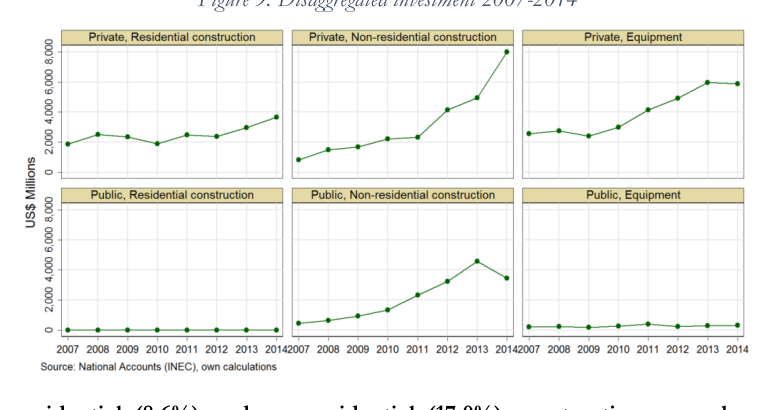
By 2015, residential (8.6%) and non-residential (17.0%) construction as a share of GDP accounted for a staggering 25.6% of Panama’s total GDP. The expansion of the Canal, and the building of roads, airports, large malls, and all the necessary infrastructure to support the services export sector, fueled a boom that allowed Panama to employ a large mass of unskilled workers, mainly in the Panama-Colón axis. Residential construction, on the other hand, grew at a similar pace than the rest of the economy, maintaining its share of GDP at 8.6% (Figure 10).
12 | Appraising the economic potential of Panama: Policy recommendations for sustainable and inclusive growth.
Figure 10. Share of GDP by sector: 2005 and 2015
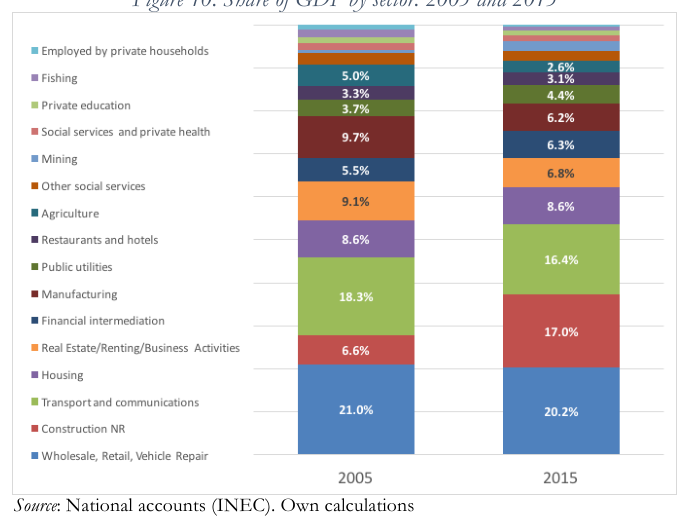
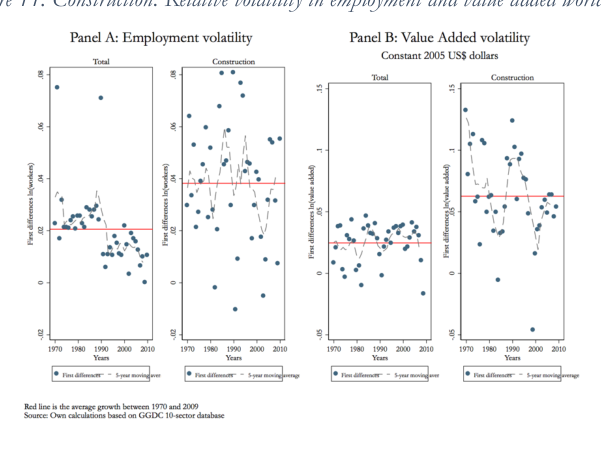
Source : National accounts (INEC). Own calculations The large construction boom allowed low-skilled workers moving out of agriculture into urban areas to earn salaries five times higher. Construction jobs as a share of total employment went from 7.5% in 2005 to 10.0% in 2015. In numbers, this translates into the absorption of 80,178 new workers in ten years. By 2015, a total of 193,558 construction workers earned a median monthly salary of US$ 500, a wage five times higher than in agriculture, and 67% higher than in manufacturing. 9 Overreliance on construction as a driver of growth exposes the economy to the high volatility that the sector displays worldwide. As depicted in the left (employment) and right (value added) panels of Figure 11, construction tends to be much more volatile than the rest of the economy. This global trend stands in sharp contrast to the steady upward tendency that the sector has displayed in Panama over the previous decade. In order for Panama’s economic expansion to remain sustainable, alternative engines of growth must be fostered.
13 | Appraising the economic potential of Panama: Policy recommendations for sustainable and inclusive growth.
Figure 11. Construction: Relative volatility in employment and value added worldwide
The construction sector has played a major role in driving two demographic patterns: ruralurban migration, and faster reduction of urban poverty. By 2015, the poverty rate in rural areas was three times that of urban areas (49.7% vs. 13.8%). 10 This is in part due to the construction boom’s effect in reducing urban poverty twice as fast as rural poverty (16.8% vs. 8.2%). Migrants coming from rural areas and comarcas 11 have poured into construction sites on the Panama-Colon axis, where the bulk of the boom has taken place. Since 2005, rural population decreased by 1.1% yearly, fueling an increase in the share of people living in cities, which by 2015 accounted for 67% of total population. The construction boom has been the main channel allowing unskilled workers to take in a share of the value added created over the decade. 12 A potential deceleration of the sector threatens to reverse some of the upward social mobility achieved and stir social unrest. That in turn feeds into the second warning sign: income inequality.
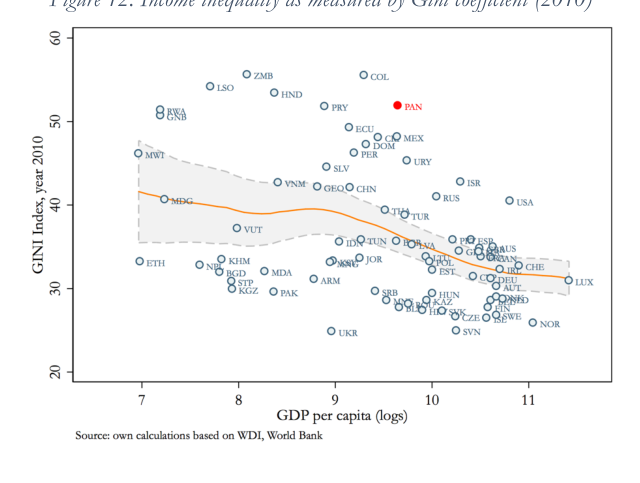
Over the fifteen year-long growth spell, the Gini coefficient of income inequality reduced from 58 to 51. 13 This makes Panama a unique case study in development: Spectacular sustained growth accompanied by poverty reduction and a more equitable income distribution. And yet, throughout this period, Panama has remained among the five most unequal countries in the world (Figure 12). 14 The country has a highly concentrated productive structure, with only 20% of GDP and less than one third of all jobs created between 2000-2010 coming out of the Panama-Colón axis.
14 | Appraising the economic potential of Panama: Policy recommendations for sustainable and inclusive growth.
Figure 12. Income inequality as measured by Gini coefficient (2010)
3. Potential binding constraints
3.1 Deceleration of the construction sector Some early indicators suggest that the construction boom may have started to wane. All leading supply-side indicators (Figure 13) point to a significant deceleration. The value of construction permits (Panel A), both residential and non-residential (Panel B), is falling, as is the production of ready-mix concrete (Panel C) and cement (Panel D). In fact, the latter metric suggests that the construction industry has been growing recently by diminishing inventories.
15 | Appraising the economic potential of Panama: Policy recommendations for sustainable and inclusive growth.
Figure 13. Construction: Leading indicators
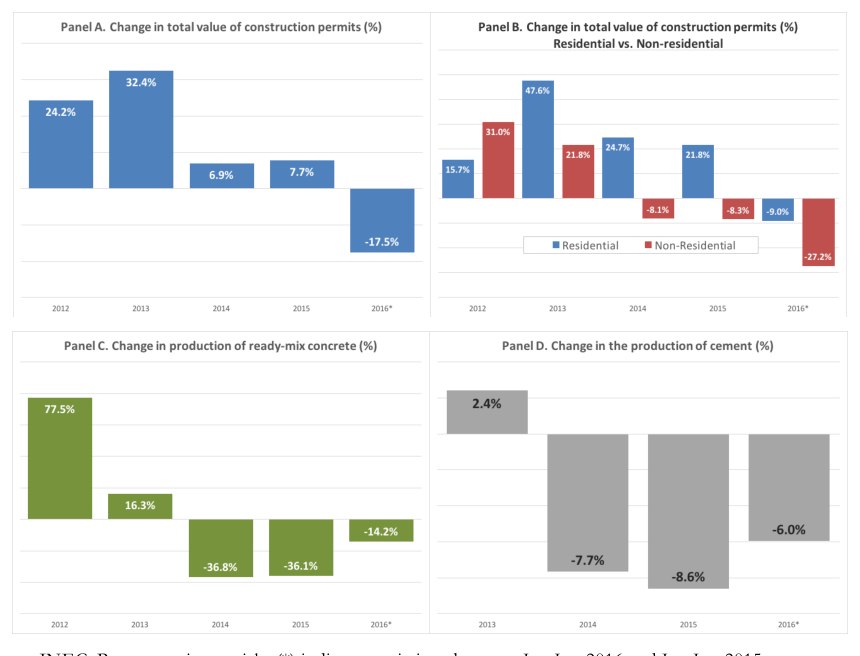
Source: INEC. Percentage in asterisks (*) indicates variations between Jan-Jun 2016 and Jan-Jun 2015.
There are also some signs of excess inventory of office and warehouse space in Panama City , resulting in a combination of higher vacancy rates and lower rents. 15 Depending on quality, vacancy rates within Panama City were anywhere between 11.5% (Class B) to 32.2% (Class A+ office space) by the end of 2015. 16 Accordingly, rent prices experienced a small downturn for the first time since 2010. For warehouses in the Panama province, vacancy rates are lower (7.2%) and prices were reported as stable over the first half of 2016. 17 16 | Appraising the economic potential of Panama: Policy recommendations for sustainable and inclusive growth.
3.2 Human capital The service sector that spurred demand in non-residential construction and accounts for most Panamanian exports is intensive in high-skilled labor. Banking, insurance, logistics, communications, information technology, and business and trade services are all dependent on sophisticated managerial and technical know-how. By 2015, the share of college-educated workers in these sectors surpassed 50%, more than doubling the national average (23.9%). Moreover, the service sectors that have gained in the share of employment during the decade (green colored in Figure 14) are intensive in high-skilled labor, whereas the sectors losing ground are all relatively low-skilled. We have already seen that construction absorbed most of the low-skilled labor released by the blue sectors, but where did the skills required by the service sector come from?
Figure 14: Share of college-educated workers, by industry
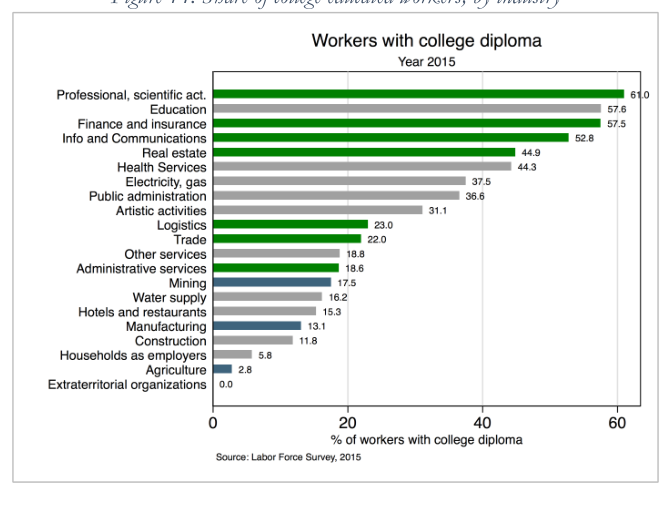
A first option would be the Panamanian education system. Panama has improved school enrollment in recent years, reaching OECD levels in both primary and secondary enrollment rates. By 2012, Panama led Latin America in secondary school completion rates, and came only second to Venezuela in tertiary education. 18 Much remains to be done within the Panamanian school system, both in terms of quality and relevance of the curriculum. In 2009, the last time that Panama participated in the standardized PISA, 19 it ranked last in mathematics, and among the worst in reading and science (63 out of 66 in both subjects). Within Latin America, Panama ranked second-to-last among the eight countries taking the tests in both science and reading, only outperforming Peru. These results were ratified in 2013 through 17 | Appraising the economic potential of Panama: Policy recommendations for sustainable and inclusive growth.
TERCE, a test measuring proficiency in mathematics, reading, writing and natural sciences. Panama placed well below the mean of fifteen Latin American countries, scoring only better than Nicaragua, Paraguay and Dominican Republic. 20 If the Panamanian education system did not produce the human capital required by the thriving service sector, where did this knowledge come from? Looking at population censuses 2000 and 2010, we find compelling evidence indicating that most of the know-how was provided by immigrants.
According to the population census, the share of immigrants in the Panamanian labor force increased from 2% to 4% between 2000 and 2010. The latter figure roughly represents 140,000 immigrants, mostly originating from Colombia (32.8%) and China (15.6%), and to a smaller extent, Nicaragua (9.1%), Dominican Republic (5.8%), and Venezuela (4.2%).
Immigrants are overrepresented in high-skilled occupations ( Figure 15 ). The share of foreignborn workers in managerial, professional and chief executive jobs is 2.6 times higher than the average share of immigrants in the economy. The proportion is similar in the case of service workers, mid-level technicians, professionals and scientists.
Figure 15. Immigrants in Panama: Overrepresentation and underrepresentation (2010)
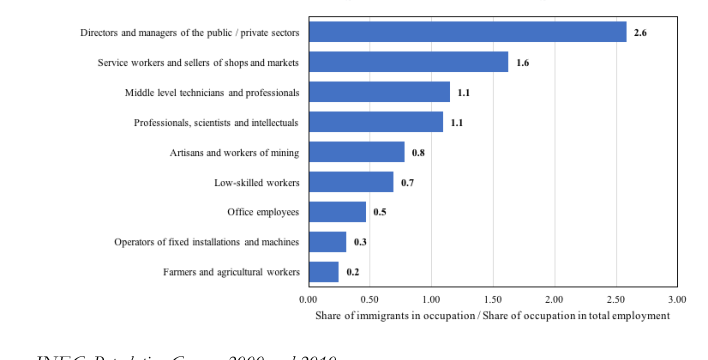
Source: INEC. Population Census, 2000 and 2010.
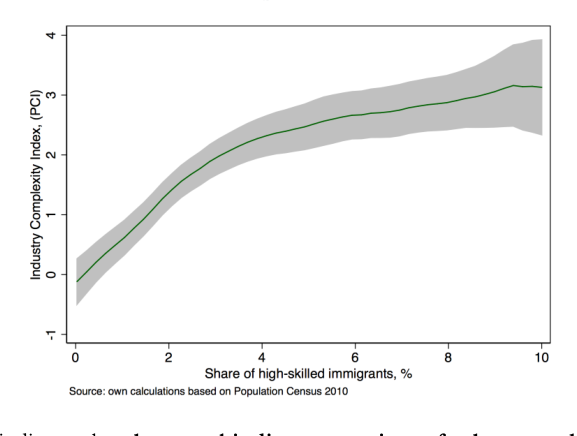
Immigrants with college degrees are also over-represented in high economic complexity industries . This confirms, yet again, how immigrants are filling positions that demand high and complex skills, for which firms are willing to pay dearly (Figure 16). 21 18 | Appraising the economic potential of Panama: Policy recommendations for sustainable and inclusive growth.
Figure 16. Economic Complexity and Skilled Immigration
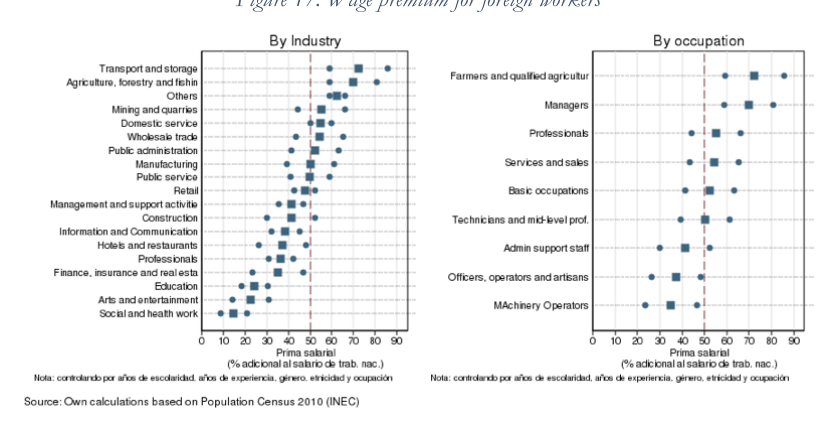
Empirical evidence indicates that the most binding constraint to further growth is human capital. This issue is evident in the significant wage premiums that foreign workers earn over otherwise identical Panamanian workers. The left panel on Figure 17 plots wage premiums of foreign workers by industry, as compared to Panamanian workers with similar schooling, experience, gender, ethnicity and occupation. 22 An average immigrant makes 50% more than a Panamanian counterpart , with the highest wage premiums registered in service sectors such as transportation, storage, and wholesale trade . All of the wage premiums by industry are positive and highly significant.
The right panel on Figure 17 ranks wage premiums of foreign workers according to occupation. Wagepremiums for foreigners are above average for qualified agriculture workers, managers, professionals, and services and sales jobs . In the manager category, wage premiums for foreigners average a staggering 70%. This data suggests that foreign workers bring a set of skills that are not easy to find in the domestic economy.
In order to maintain the competitiveness of the service sector and to reduce wage premiums, Panama must increase the supply of high-skilled workers. Investing in improving the quality and relevance of education is a long-term strategy towards that goal, but Panama cannot afford to wait. In the short to medium term, an increase the supply of human capital can only be achieved by increasing the number of qualified immigrants.
19 | Appraising the economic potential of Panama: Policy recommendations for sustainable and inclusive growth.
Figure 17: Wage premium for foreign workers
3.3 Barriers to the attraction and diffusion of knowledge The increase in the stock of immigrants reported in the previous section was the result of deliberate efforts on the part of Panamanian policymakers. In 2007, a bill was passed creating a special regime for all multinational company headquarters operating out of Panama (SEM Law, or Law No 41). 23 That same year, an industrial park – Panama-Pacific (PP) – was created on the site of a former U.S. military air base (Howard). Features designed to attract companies to PP include tax exemptions; special incentives for immigrants; special labor and customs regimes, and a “one-stop shop” government facility to reduce bureaucracy. The PP industrial park is the third and most recent addition to a group of special zones in Panama. City of Knowledge (CK), a technology park aimed at fostering innovation, was founded in the year 2000 in the former military barracks (Clayton) surrounding the Panama Canal. The Colón Free Zone (CFZ) was created in 1948, and is the world’s second-largest oldest importexport zone. CFZ has remained a spearhead of Panama’s accelerated growth by channeling the traffic of goods coming from Asia to Latin American and the Caribbean. Figure 18 summarizes the characteristics of these three special economic zones (SEZ), and the special provisions that have been granted to companies operating within their premises. 24 20 | Appraising the economic potential of Panama: Policy recommendations for sustainable and inclusive growth.
Figure 18. Panama: Special Economic Zones
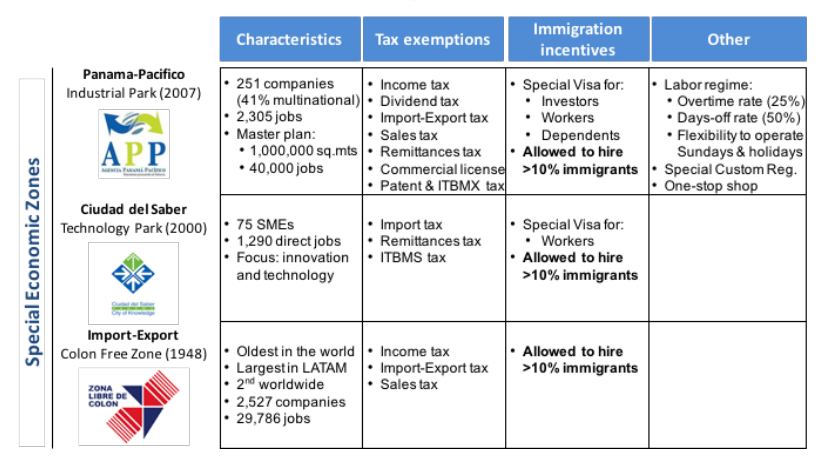
Thanks to the SEM law passed in 2007, over 120 companies have relocated their regional headquarters to Panama. Some of these have settled within the grounds of PP, which today hosts over 250 national and multinational companies. Policy tools such as SEZs have been successful in attracting the knowhow required to foster growth in Panama’s service sector. The increased availability of these skills has, in turn, been instrumental in attracting the foreign investment necessary to materialize these business opportunities.
Despite these successful efforts in bringing immigrants to Panama, several issues persist. The problems with skill immigration are twofold. First, there are not enough foreign workers to keep up with the accelerated growth registered in Panama , as evidenced by the high wage- premiums to foreigners discussed in the previous section. Moreover, there are a number of restrictions embedded into the Panamanian immigration laws that limit the free flow of knowledge and inhibits technological diffusion, and therefore prevent the full economic potential of skilled immigration from being realized. These restrictions hinder the spillover of know-how, which remains locked within the gates of multinational companies and SEZs.
The special visas granted to foreign workers who move to Panama sponsored by multinational companies cease as soon as the contractual relationship between them comes to a halt . Under the provisions of the SEM Law and SEZs, years accumulated by foreign workers in Panama are not considered valid for residence purposes . Expatriates do not have a path to residence, let alone citizenship, and their dependents are not allowed to work . Moreover, working visas must be renewed yearly at a hefty fee (US$2,000-3,000), a relatively negligible sum for large multinational companies, but a harmful expense for the small and medium enterprises hosted at CK. Additionally, firms outside SEZs and those not subject to exemptions granted by the SEM Law can hire a maximum of 10% foreign labor.
21 | Appraising the economic potential of Panama: Policy recommendations for sustainable and inclusive growth.
All sixteen companies we interviewed at CK park complained that the annual cost of working visas for foreign employees consumes a significant portion of the budget they would otherwise devote to research and development. Companies hosted by CK must comply with a requirement of constant innovation as a condition for remaining in the park, as determined through a review carried out halfway through their lease contracts (every two or three years, depending on the contract). When companies decide to move past the innovation stage and on to the commercialization phase of their business, they risk being expelled from the technology park. Once this happens, foreign workers fall into a legal limbo, as their working visas are not valid outside of CK.
Some immigration provisions prevent foreigners from even considering Panama as a destination . Current legislation establishes a long list of occupations and professions reserved exclusively for Panamanians . 25 These include different types of engineering fields, chemists, architects, agricultural scientists, and the cluster around medical services: doctors, nurses, medical assistants, radiologists and even chiropractors. Job restrictions are applied universally, and they do not discern between the origin of a foreign worker’s education, affecting even those who studied in Panama. The son of a Nicaraguan immigrant couple who moved to Panama as an infant, was raised and schooled in the country, and graduated as an M.D. from a Panamanian university, is not allowed practice medicine once he has become a doctor. 26 Foreign nationals are not allowed to teach at Panamanian universities . There are ways to circumvent this restriction, such as carrying out the actual teaching sessions within one of the SEZs (i.e . City of Knowledge), or labeling the course as “in-house” training for one of the multinational companies protected under the SEM Law. While these practices allow for the transmission of knowledge from foreigners to locals, they only occur on a small scale and cannot be implemented widely within the context of public universities.
Additional restrictions to entry – on the grounds of national security – further compound the series of obstacles that immigrants in Panama face. Panamanian authorities have established a list of “restricted citizenship status” for nationals belonging to 62 countries considered “threats to national security.” The list is mostly composed of African and Asian countries, including India, Indonesia, Pakistan, Bangladesh, Sri Lanka, Albania and China. 27 Citizens of these countries are subjected to a lengthy and bureaucratic process called “authorized visas,” which may take over a year to complete and carry hefty costs. Three private immigration law firms that were interviewed for this study confirmed that the processing of authorized visas has been reported as a source of corruption within the Panamanian foreign service system.
25 Restricted professions, with the corresponding year of the Law or Decree in parenthesis are: education in the areas of history, geography and civism (1946), nursing (since 1954), barbering and cosmetology (1956), odontology (1956), architecture (1959), agricultural sciences (1961), pharmacy (1963), civil engineer (1965), chemical engineer (1965), chiropractic (1967), nutrition (1969), medicine (1970), psychology (1975), medical assistantship (1975), accountability (1978), journalism (1978), laboratory technicians (1978), public relations (1980), speech therapists (1980), medical radiology (1980), economists (1981), social work (1981), veterinary (1983), physiotherapy (1984), law (1984), dental assistant (1994), sociology (1996), chemistry (2001). 26 The example comes from a true story we collected and verified in our round of interviews in Panama City. 27 An exception form the authorized visa process was made via SEM Law, allowing Chinese workers coming into Panama with Chinese companies.
22 | Appraising the economic potential of Panama: Policy recommendations for sustainable and inclusive growth.
All in all, these numerous and stringent immigration restrictions are preventing Panama from attracting and retaining the people with the know-how and capabilities required to continue growing at a sustainable pace. Moreover, they limit the positive spillovers that immigrants already in Panama could have for the rest of the economy.
The most puzzling feature of these restrictive policies is that they do not benefit Panamanian workers. Based on the extensive literature devoted to measuring the economic impacts of immigrants on local workers, we studied the wages of Panamanian workers as a function of immigrant participation in their industry-province. 28 The evidence for Panama indicates that immigrant workers are not a substitute to local workers, but rather a complement. An increase of 10 percentage points in the share of immigrants at the industry-province level is associated with an average increase of 3.6% in the salaries of Panamanian workers (Figure 19). These results reinforce the notion that immigrants bring skills that complement the capacities of Panamanian workers, ultimately resulting in higher productivity and wages for the latter. Moreover, the effects are higher when it comes to Panamanian low-skilled workers. 29
Figure 19: Correlation of immigrant flows and changes in wages of local workers
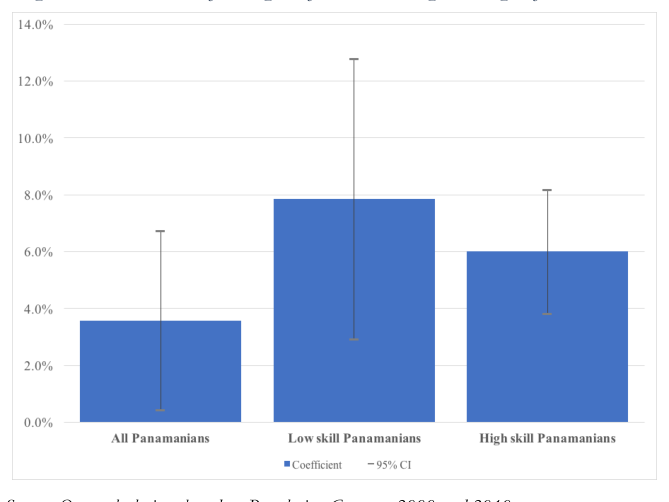
Source: Own calculations based on Population Censuses 2000 and 2010 23 | Appraising the economic potential of Panama: Policy recommendations for sustainable and inclusive growth.
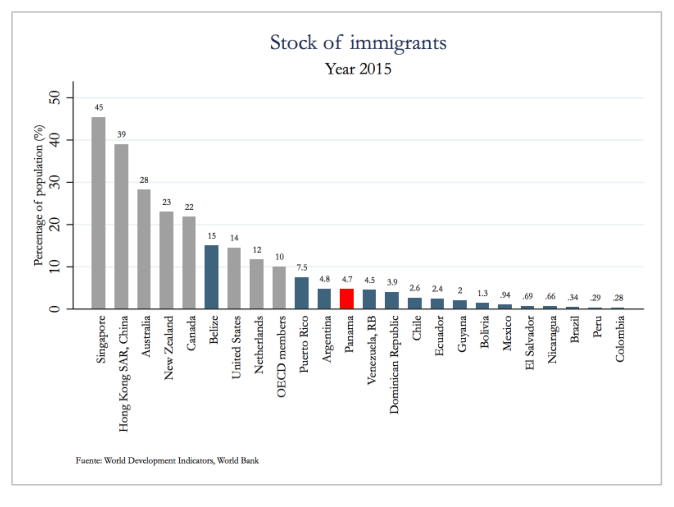
broadcasts, as well as on social media. However, this notion is not supported by facts. According to the World Bank, the share of immigrants in Panama reached 4.7% of total population in 2015. While this number lies above the Latin American average (Figure 20), it is well below countries with economies grounded in a thriving service sector, such as Singapore (45%), Hong Kong (39%), or the Netherlands (12%). Panamanian officials often cite Singapore as a model, but it is hard to be Singapore without fostering the know-how embedded in skilled migrants.
Figure 20. Immigrants in the labor force by 2015
In the past, Panama has demonstrated its capacity to assimilate the know-how brought in by foreigners and to leverage it towards promoting growth and better salaries for Panamanians. The most dazzling example is the Canal itself, managed with significant skill, efficiency and transparency by a team of Panamanian workers, gathered under the umbrella of an autonomous government agency ( Autoridad del Canal de Panamá or ACP). The Panamanian-run ACP has successfully managed and even expanded the Canal, as well as promoted the development of a modern service sector that multiplied its impact on growth and employment in activities surrounding the Canal. The thriving banking system is an analogous case, as it has benefited from a large inflow of foreign executives brought by multinational banks, who in turn bolstered the growth of a competitive domestic banking sector. Copa Airlines, which at first relied almost exclusively on foreign pilots, who then went on to train their Panamanian counterparts to accommodate its steady growth, is another formidable example. Panama could have not provided skilled pilots, because it did not have a competitive airline; and the lack of pilots in itself was a significant constraint to the existence of an airline. Imported knowhow used to train Panamanians was the device that allowed a solution to this chicken-and-egg dilemma.
Today, Panama is not maximizing the potential spillovers of foreign workers that have come to Panama under the special provisions of the SEM Law and the SEZs. Restrictions to the 24 | Appraising the economic potential of Panama: Policy recommendations for sustainable and inclusive growth.
attraction, settlement and free-flow of immigrants will only harm the modern service sector and its exports. As reported above, skilled labor is one of the most binding constraints to further growth in the service sector. Lower growth would only translate into lower demand for construction and reduced jobs for domestic low-skilled workers. These effects threaten to put a halt on the social progresses Panama has achieved in the previous fifteen years in terms of upward social mobility (Figure 2) and lower inequality.
4. Policy Recommendations
Three elements stand out as cornerstones of a policy aimed at promoting sustained and equitable growth: (i) The attraction and retention of human capital; (ii) the maximization of the diffusion of know-how and knowledge spillovers, and (iii) the tackling of coordination problems that are hindering economic activity outside the Panama-Colón axis.
In addition to these three binding constraints, our Growth Diagnostic for Panama (Hausmann, Espinoza, and Santos, 2017) identified a number of additional elements that other actors looking into Panama have also underscored. 30 The quality of education , and its curriculum’s lack of relevance for the Panamanian economy, stand out as factors driving income inequality and threatening growth prospects in the medium term. Another usual suspect is the quality of institutions , which manifests as a constraint in the form of red tape, corruption and lack of transparency . No matter how it is measured, the quality of institutions in Panama lies well below that of other countries with similar income per capita.
It is not a coincidence that the “one-stop shop” of 18 government agencies in PP was reported by surveyed tenants as its highest-rated component. 31 That signals that agents are willing to pay higher rents in PP in order to overcome the constraint. Businesses importing to or exporting out of PP or CFZ often complain that administrative processes are inefficient and tardy. These elements suggest that for industries outside of SEZs, red tape might be significant . Panama lags behind the Latin American average in indicators such as government effectiveness regulator quality, 32 and senior executives reportedly spend a third of their time dealing with legal requirements and business regulations. Panama’s metric is twice the Latin American average (14%), and three times the level of OECD countries (9.7%). 33 Business surveys point to “inadequacies of the court system” and “ corruption ” among the most important constraints to private economic activity in Panama. This is another area where the performance of Panama is inconsistent with its level of income. Corruption seems to be somewhat related to red tape: according to enterprise surveys, instances of corruption show up in the amount and frequency of bribes and kickbacks paid to get things done. 34 25 | Appraising the economic potential of Panama: Policy recommendations for sustainable and inclusive growth.
Lack of transparency in public sector procurement was another institutional factor often cited during interviews we conducted with government officials and private sector groups. Public sector spending would highly benefit from introducing more accountability, monitoring and effectiveness evaluation mechanisms, freeing up resources that could in turn be used to strengthen public infrastructure and to expand the network of social services in the Panamanian province.
Improving the quality of education and building up institutional capacity are challenges that Panama must tackle in its quest to continue growing at a fast pace while reducing poverty and inequality. Unfortunately, these are also areas where progress will be slow in coming. 35 We understand that a long list of policy interventions will not be helpful , so we have prioritized our recommendations towards solving the most binding constraints we have found, so they may be implemented in a reasonable timeframe by the institutions that Panama already has in place .
Policy recommendation 1: Ease restrictions preventing skilled migrants from coming to/settling in Panama As we have stressed, Panama has chosen a highly-specialized development path. For the country to continue its upward trend, it is essential that the government continue to open business opportunities in the service sector, so that FDI continues flowing. The service sector is also an important source of demand for non-residential construction, one of the transmission channels allowing unskilled workers to share in the benefits of growth. As we have seen, the bulk of growth in Panama has been propelled by public infrastructure, private non-residential construction, and exportable services. In spite of all the progress achieved, when we contrast Panama with other places with service-driven growth models (such as Singapore, Hong Kong, South Korea) or OECD countries ( Figure 21 ), some areas of improvement (infrastructure, competence and quality) become evident. 36 26 | Appraising the economic potential of Panama: Policy recommendations for sustainable and inclusive growth.
Figure 21. Logistics Performance
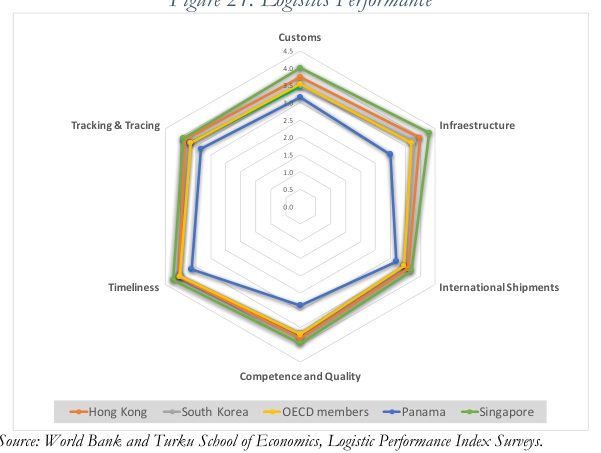
Sustaining the momentum in the service sector requires human talent and skills that are not abundant in Panama. Investing in improving school enrollment and the quality of education, making it more relevant to the needs of the Panamanian economy, is a necessary strategy whose results will be slow in coming. Making Panama more attractive to the highly-skilled migrants that the service sector requires in order to remain competitive is the most viable policy strategy .
Panama has burdensome immigration regulations. Legal frameworks that prove to be inconvenient for specific cases are solved via exceptions or special provisions. These provisions have turned immigration and work permit processes into a web of highly complex and discretionary administrative practices, for the benefit of a small number of private law firms. These features are highly prone to suffer from the maladies of corruption mentioned above. 37 Over the previous fifteen years Panama has pursued a puzzling immigration policy: restricting the inflows of skilled migrants while launching periodical drives for legalizing low-skilled ones (Crisol de razas). This strategy is a recipe for inequality, as it increases the supply of unskilled workers at the bottom of the wage distribution, while it restricts the supply of qualified workers at the top. Our policy recommendation is somewhat inverted: the implementation of policies to attract and retain highly-skilled immigrants – so that wage premiums at the top of the distributions are reduced – while they help Panamanians at the bottom to be more productive.
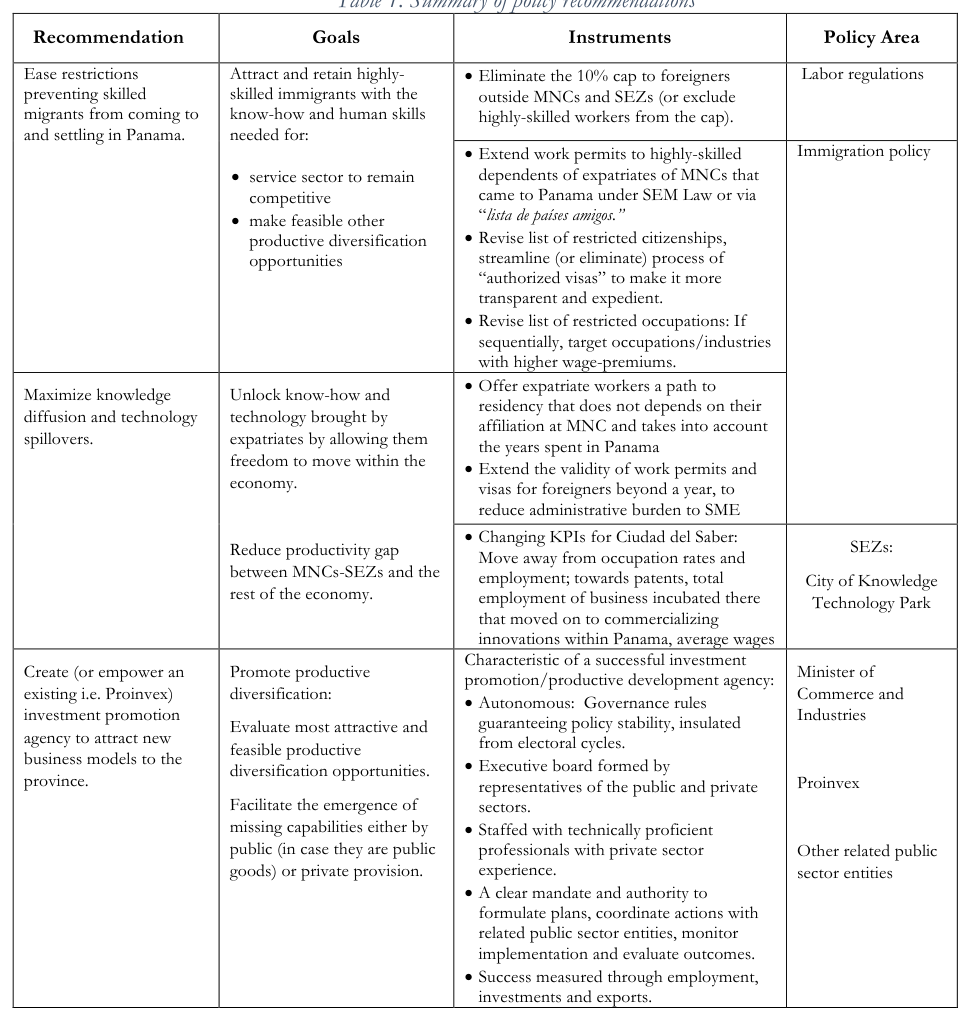
Our recommendations are focused on revising and eliminating the restrictions outlined in section 3.2 and summarized in the first panel of Table 1. Our analysis indicates that Panamanian firms are paying high premiums for skilled foreign workers (Figure 17). Those premiums are signaling that immigrant’s skills are not abundant and therefore firms are willing to pay dearly for them. We have also established 37 As stated by one of the Secretaries of State interviewed for this project: “Panama is a country with one of the strictest immigration regulations, which are in turn applied in one of the most lenient ways”.
27 | Appraising the economic potential of Panama: Policy recommendations for sustainable and inclusive growth.
that these immigrants do not compete with domestic workers, but rather complement them (Figure 19).
One of the most notorious restrictions is the 10% cap of foreign workers applied to all companies except MNCs headquarters and SEZ firms. Our analysis based on the population census indicates that productivity within PP is significantly higher than elsewhere in its host province (Hausmann, Obach and Santos, 2017), which in turn leads to higher salaries. There are many reasons behind productivity differentials (Figure 18), but the fact that companies within PP have no limits to the percentage of foreign workers allowed in their payroll is surely one of them. Foreign workers bring new skills than can be combined with those of domestic workers, which allows for the production of more complex goods and services that can sustain better salaries, while providing domestic workers the opportunity to assimilate skills in learning by doing.
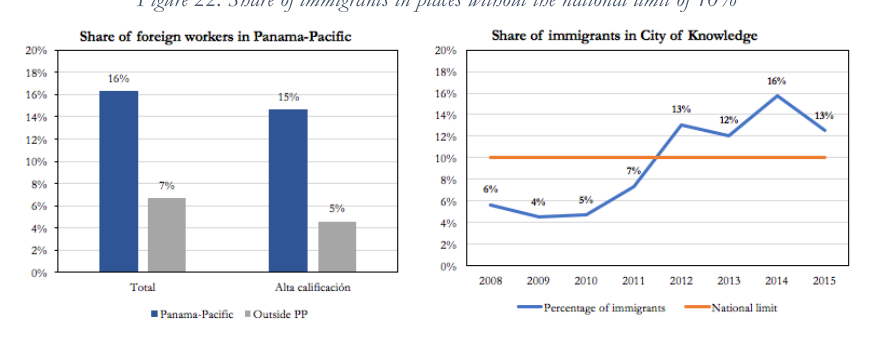
What happens when firms are not bound by the 10% cap? The answer is depicted in Figure 22. The 10% cap is indeed a binding constraint, as firms within PP (16%) and CK (13%) are all beyond the threshold. In the former, the number of highly-skilled workers triple that of the firms within the same province but outside the zone. But the percentage of foreign workers has not skyrocketed (given the level of wage premiums, it would have been surprising if it had). Raising the cap for highly-skilled foreign workers or eliminating it altogether will only benefit Panamanian firms and workers not protected by the SEM Law or SEZ exceptions.
Figure 22: Share of immigrants in places without the national limit of 10%
Extending work permits to highly-skilled dependents of expatriates in Panama is another lowhanging fruit . These are people who have already settled in Panama, and allowing them to engage in high-skill jobs would only reduce the shortage of human capital at zero cost, making Panama more attractive to foreign families who bring in skills and talent, which would in turn increase the chances of knowledge diffusion. 38 Two other policy instruments that we recommend revising or even possibly eliminating are the lists of “restricted citizenships” and “restricted occupations.” Companies within SEZs can normally 28 | Appraising the economic potential of Panama: Policy recommendations for sustainable and inclusive growth.
find a way to circumvent these restrictions, but firms in the rest of the economy rarely do. These lists only heighten the wage and productivity disparities between MNCs and firms in SEZs, and the rest of the economy. The political economy of reforming immigration law might call for a strategic approach, a sort of prioritization criteria to begin easing these constrains. In this case, wage premiums (and therefore, the skills that are scarcer) will help in prioritizing sectors and occupations. This can only be considered an intermediate solution, because the fact remains that for Panama to diversify its productive structure, it will have to develop and intensify industries that are not yet present and therefore would not be covered under the wage-premium criteria. Another top priority would be to introduce provisions allowing foreign instructors to teach at Panamanian universities and technical schools.
Recommendation 2: Maximize knowledge diffusion and technology spillovers Previous administrations in Panama have realized the importance of immigration and promoted public policies accordingly, such as the SEM Law (2007) and SEZs (CK, 2000; PP, 2007). These have been instrumental to Panama’s accelerated expansion. Once inside Panama, however, the free-flow of foreign workers and expatriates within the economy is highly restricted. These restrictions – described in section 3.3 – prevent the knowledge and skills brought by foreign workers to radiate into the rest of the economy. Our second set of recommendations is related to policies aimed at promoting spillovers by unlocking knowledge from MNCs and SEZs.
These recommendations involve offering a path to residency for expatriates , so that they have the option of leaving MNCs and moving to another job or even establishing their own business. This is an important channel of knowledge spillovers, given than immigrants are six times more likely to become entrepreneurs than Panamanians. 39 Within this category, we also suggest extending the validity of working visas beyond a year and reducing associated costs , in order to ease the burden of hiring foreigners in small and medium enterprises (SMEs). These businesses are particularly prevalent in CK, a technology park focused on innovation that relies heavily on specialized foreign labor who must pay a heavy burden every year in legal fees to have their visas renewed.
A related recommendation for the City of Knowledge administrators would be to reformulate the key performance indicators (KPIs). At present, the management of the technology park focuses on occupation rates and total employment. Our advice would be to measure their success in terms of their ultimate contribution to the Panamanian economy, and start thinking in terms of patents, number of firms incubated at CK that have moved on to commercialize their innovations within the Panamanian economy, number of jobs created by these firms and average wages.
29 | Appraising the economic potential of Panama: Policy recommendations for sustainable and inclusive growth.
Policy Recommendation 3: Create an investment agency to attract new business models to provinces One of the most daunting challenges that Panama faces is overcoming income inequality. Inequality manifests in two different aspects, which deserve differential policy treatments. The first is the large concentration of poverty in the indigenous provinces (comarcas). For starters, one of the most troubling signs is that the National Institute of Statistics and Census (INEC) does not compute GDP for comarcas . The omission is far from inconsequential: Despite representing only 6.3% of the population, these provinces are home to 22.6% of Panama’s poor. Poverty and extreme poverty in comarcas exceed 90% and 80% respectively, surpassing levels of other indigenous communities in Latin America. Accordingly, internal migrations within Panama are reported to be higher than elsewhere in the region. 40 In the short-term, the challenge for the Panamanian government in the comarcas is expanding the coverage of basic public services while at the same time fostering opportunities for productive diversification without interfering with their own usos y costumbres . 41 Our policy recommendations will focus on the second aspect of the inequality problem: Large productivity differences between the Panama-Colón axis and the rest of the provinces . As mentioned in Section 2, only one-fifth of the GDP and one-third of all jobs created between 2000- 2010 came out of Panama-City Colón. In order to promote more equitable growth, Panama needs to attract new business models to its provinces.
Unfortunately, the bulk of economic activity taking place outside Panama-Colón is centered around a few primary commodities that do not require complex capabilities (Hausmann, Morales and Santos, 2017). If we exclude services, the country’s net exports in 2014 totaled less than 0.5% of GDP (US $1.220 million), comprised mostly of vegetables (31%), minerals (25%), metals (9%), animal products (8%), wood (7%) and foodstuffs (7%). None of these require complex capabilities. In this regard, most provinces face a chicken-and-egg dilemma: They do not have the capabilities to diversify into more complex industries and products, which in turn do not exist because these places lack the capabilities required. Hidalgo and Hausmann (2009) have provided insights into how societies have solved this dilemma: Countries and regions do not diversify at random; rather, they spread towards activities that demand knowledge and capabilities that are similar to those required by industries already in place .
This means that not all economic activities are equally likely in all places. It also implies that even the most likely opportunities for productive diversification will share capabilities with industries already in place, and that there are also some capabilities that are missing. Monitoring the most attractive and feasible opportunities for export diversification and facilitating the appearance of missing capabilities is a challenge that could be tackled by an innovative institutional mechanism that promotes effective public-private dialogue (Crespi et al., 2014).
An investment promotion agency responsible for assessing the productive potential of each province should not add another layer of bureaucracy to the public-sector infrastructure, and 30 | Appraising the economic potential of Panama: Policy recommendations for sustainable and inclusive growth.
instead engage the private sector in a new relationship with the State . This agency should promote a private-public, public-public, and private-private dialogue, where firms and the government learn about underlying costs and opportunities and engage in strategic coordination (Rodrik, 2004). These mechanisms could take an array of legal and institutional forms, but should leverage on the capacities already in place at the regional level. Following several successful cases in Latin America, a typical investment promotion agency should carry out the following activities: 42 • mapping and selecting industries to be supported in the targeted territory • identifying challenges and needs for policy intervention with the participation of both public and private sector actors • implementing actions identified in the second stage • continuous monitoring and evaluating The main challenge for the successful set up of this agency is institutional. The right model for an industrial policy of this type need not focus on policy outcome (e.g. picking a winner industry), but on getting the policy-process right . The agency must navigate through the existing bureaucracy of multiple government agencies that have some responsibility in productive development, both at a national and at regional levels. In addition, it will have to build long-lasting bridges with the private sector, so the latter group can disclose proper and accurate information on the self-discovering process of new products (Hausmann and Rodrik, 2003).
Within the set of existing public institutions, Panama has an agency (Proinvex) under the tutelage of the Ministry of Commerce and Industries that could potentially be empowered and upgraded to fulfill this role. For Proinvex to be successful in attracting new business models to the province, some elements of institutional design need to be considered. 43 • The agency must be effectively autonomous , with a rotating executive board composed of representatives of the public and private sectors, and a set of governance rules that guarantees policy stability, isolating its functioning from electoral cycles. • The agency should be staffed with technically proficient professionals with private sector experience (sectorial experts must understand industry trends, business strategy and strategic analysis). 44 These features will allow the agency to provide a thorough evaluation of the sectors with highest potentials, assess the public goods required, and inform the board on the process of choosing the most efficient ways to facilitate their provision. • The agency should be funded jointly by the public and the private sector , 45 and be given a clear mandate and authority to formulate plans, coordinate actions with those of other related public sector entities, as well as constantly monitor implementation and evaluate outcomes.
31 | Appraising the economic potential of Panama: Policy recommendations for sustainable and inclusive growth.
The agency should have access to public resources that might help in providing missing public inputs required by potential industries. • The success of the agency must be measured by key performance indicators (KPIs) such as employment, investments and ultimately exports.
The economic complexity methodology offers a road map for productive diversification that is both analytically rigorous and politically impartial. It provides an automated process, that leverages the capabilities required by the industries already in place in every region, and identifies attractive industries that share some of these capabilities (adjacent possible) and are either absent or not present in the intensity one would predict. The industries identified through this methodology, however, should neither be taken uncritically nor as a list of picked winners, that automatically move on to receive government support. The emphasis here is on changing the nature of the dialogue between the public and private sectors, focusing on the capabilities missing for potential industries to materialize, and the more convenient way to facilitate their provision. In that process, some factors that we have not identified as binding constraints at the national level might be effectively be binding at the regional level. Likewise, the strategies aimed at iteratively solving these constraints might differ across regions. Decision makers must be acquainted with the particularities of each region, both from an industry and form a public-goods provision standpoint.
32 | Appraising the economic potential of Panama: Policy recommendations for sustainable and inclusive growth.
Table 1. Summary of policy recommendations
33 | Appraising the economic potential of Panama: Policy recommendations for sustainable and inclusive growth.
5. The economic complexity of the Panamanian provinces: Identifying potential opportunities for productive diversification The economic complexity methodology offers the analytical rigor, clarity and impartiality for identifying potential sectors by regions and kicking off a process that will lead to a whole new type of relationship between the private sector and the State. Hausmann, Morales and Santos (2017) tested three different ways to measure technological proximity between industries in Panama, and ranked them according to their capacity to predict the appearance or disappearance of industries. The best predictive capacity was achieved by the proximity measures derived from occupation similarities between industries.
In this section, we draw from this document and illustrate results for two very different provinces: Chiriquí and Darién. We have identified sectors with potential in these places, and delve into the feasibility analysis of these market opportunities by introducing demand side considerations . The main goal of this section is to offer a roadmap for policymakers to identify and select key sectors, one of the core activities of the investment promotion agency proposed above. It is worth mentioning that the list of recommended sectors presented here should not be taken at face value, but only as a roadmap to guide the search for strategic sectors in each province. The final targeted sectors should ultimately emerge from an iterative and dynamic process carried jointly by the private and the public sector.
Based on relative employment, Hausmann, Morales and Santos (2017) identified industries with relative comparative advantages for nine Panamanian provinces. 46 Based on occupation proximities, economic complexity and strategic criteria, they then moved on to identify the diversification opportunities into nearby or adjacent sectors . 47 The output of this process is a list of the most attractive productive diversification opportunities. 48 These diversification opportunities coming out of the complexity profile are based on supply-side factors, namely the portion of productive capabilities these industries share with the ones that are already on site in each place. In order to assess the potential of these industries, we need to take into account other factors such as their relative market strength – both locally and globally – and how attractive labor market conditions are for workers in these sectors.
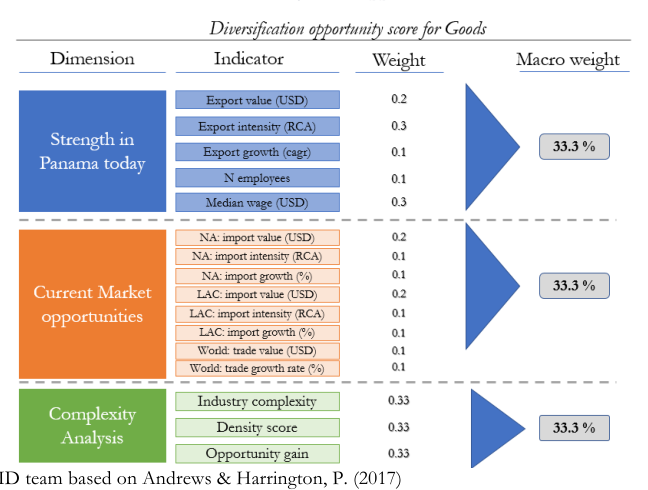
Following a methodology developed by a partnership between the CID team and the government of Sri-Lanka (Andrews and Harrington, 2017), we provide an example of how to enhance the complexity analysis by pondering additional factors. We created a product/activity index that includes different features of the national and global market for each potential product. Namely, we analyze three specific dimensions: strength in the local market in Panama; global market opportunities and level of complexity ( Figure 23 ).
34 | Appraising the economic potential of Panama: Policy recommendations for sustainable and inclusive growth.
Figure 23: Diversification opportunity score
Source: CID team based on Andrews & Harrington, P. (2017)
The first dimension (strength in Panama today) considers the performance of the industry elsewhere in Panama . In particular, we weight the level and trend of the Panamanian exports for the industry, and the size and quality of the local labor market. The second dimension assesses the global market opportunities for the industry . Here we ponder the import levels of Panama’s main and most natural trade partners: countries from North America and Latin America and the Caribbean. The third dimension relates to the complexity analysis mentioned at the beginning of this section, which captures how complex these industries are, how strategic they are (in terms of access to other complex industries) and their distances – in terms of capabilities – to industries already in place.
A key element of this analysis is the selection of weights to compute the final score per industry/product. The weights depicted in Figure 23 are only an example for illustrative purposes. Establishing a consensus around these weights is part of the dynamic process that a promotion agency is expected to carry out. The quality of the outcome depends on an iterative process with tight feedback loops, during which the team can learn from its own experience (Andrews, Pritchett & Woolcock, 2013). Again, the engagement of the CID with the Sri-Lankan government officials can serve as a good benchmark for this purpose.
As an didactic exercise, we apply this framework to two showcase provinces in Panama: Chiriquí and Darién. These provinces may serve as good illustrative examples for several reasons. First, both provinces are on the geographic extremes of the country, located far away from the interoceanic region and thus, benefiting the least form all the activities that surround the Canal. Second, both provinces are also different when it comes to the stock of productive capabilities already installed. While Chiriquí has some industry base that can help in identifying nearby productive diversification opportunities of relative low risk, Darién is only able to manufacture a few agricultural products of low complexity. In the latter case, the role of the State in helping Darién to overcome the chicken-and-egg dilemma should more active, and the risks associated are significantly higher.
35 | Appraising the economic potential of Panama: Policy recommendations for sustainable and inclusive growth.
The case of Chiriquí Our preliminary results suggest that among the 30 products that present diversification opportunities for Chiriquí, goods related to aquiculture such as the processing and preparation of fish products stands out as a highly attractive industry ( Figure 24 ). 49 Processed fish products not only have an above-average complexity for Chiriquí, but are also a source of well-paying jobs for Panamanian workers. By 2010, there were more than 1,500 workers in this industry with a median salary of US$ 385, much higher than the median salary of the agriculture sector (US$ 200). In addition, fish imports from both North America and Latin America have been trending upwards over the last years.
Chiriquí can leverage its abundant natural resources such as forests and minerals to foster the creation of a hub for construction materials. In particular, the province can take advantage of its abundant stock of natural resources such as silver, zinc, molybdenum (CAF, 2014) to develop the production of manufacturing and construction products derived from these minerals. In addition, Chiriquí already has activities related to forestry, sawmilling, and planning of woods in place, which can be steppingstones for the creation of a hub for wood-related materials that can nurture an increasing demand for construction and public infrastructure within the region and nationwide.
There is a promising overlap between our recommendations and the findings of two other studies related to Chiriquí’s development strategy (CAF, 2014; CAF, 2016) . In particular, these studies have also highlighted aquiculture and logistics as the main engines of Chiriquí’s future growth. On top of these, our analysis has also uncovered substantial diversification opportunities related to construction and construction materials ( Figure A- 1 ). On the other hand, these studies emphasize agriculture and tourism as potential sectors, which do not show up in our analysis.
36 | Appraising the economic potential of Panama: Policy recommendations for sustainable and inclusive growth.
Figure 24: Diversification opportunities for Chiriquí
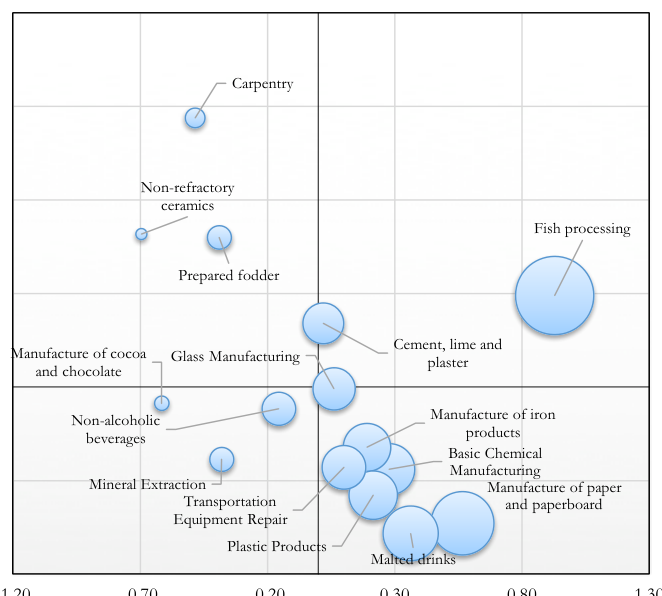
Complexity Strength in Panama Note: The size of the bubbles represents the global market opportunities of the product. Source: CID own calculations.
37 | Appraising the economic potential of Panama: Policy recommendations for sustainable and inclusive growth.
The case of Darién Located in the Southeastern part of the country, next to the border with Colombia, Darién remains one of the least developed provinces in Panama. Hosting 60% of the country’s land suitable for crop, pasture and forestry activities, the economy of this province revolves around agricultural activities of very low productivity. In addition, its population is characterized by being scarce, heterogeneous and disperse. For this reason, the productive capabilities of Darién workers are low in complexity. Given its disadvantaged position in terms of productive capabilities, in order to diversify its economy, Darién will have to make strategic bets and jump into new activities that lie relatively far from the current ones in place .
Figure 25 shows a list of the nine most attractive opportunities for productive diversification in tradable goods. 50 Foodstuffs processing, dairy and ice cream stand out as products with an attractive combination of complexity, strength in Panama and global market opportunities.
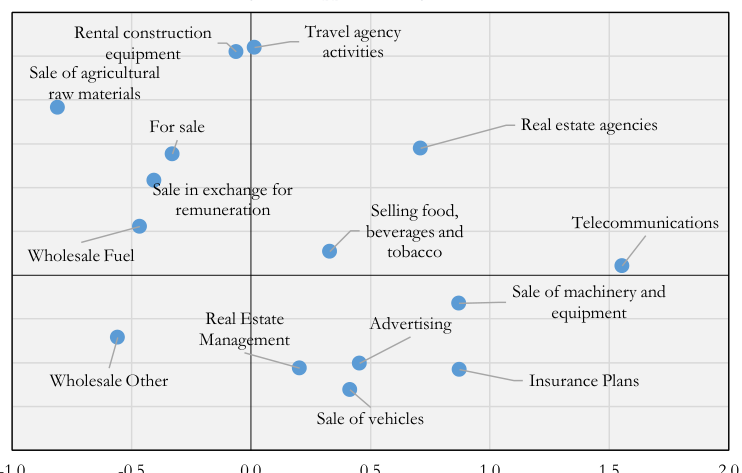
Moreover, when compared to the non-tradable activities mentioned above, these manufactured products present stronger linkages with the current agricultural activities of the province.
Figure 25: Diversification opportunities for Darién – goods
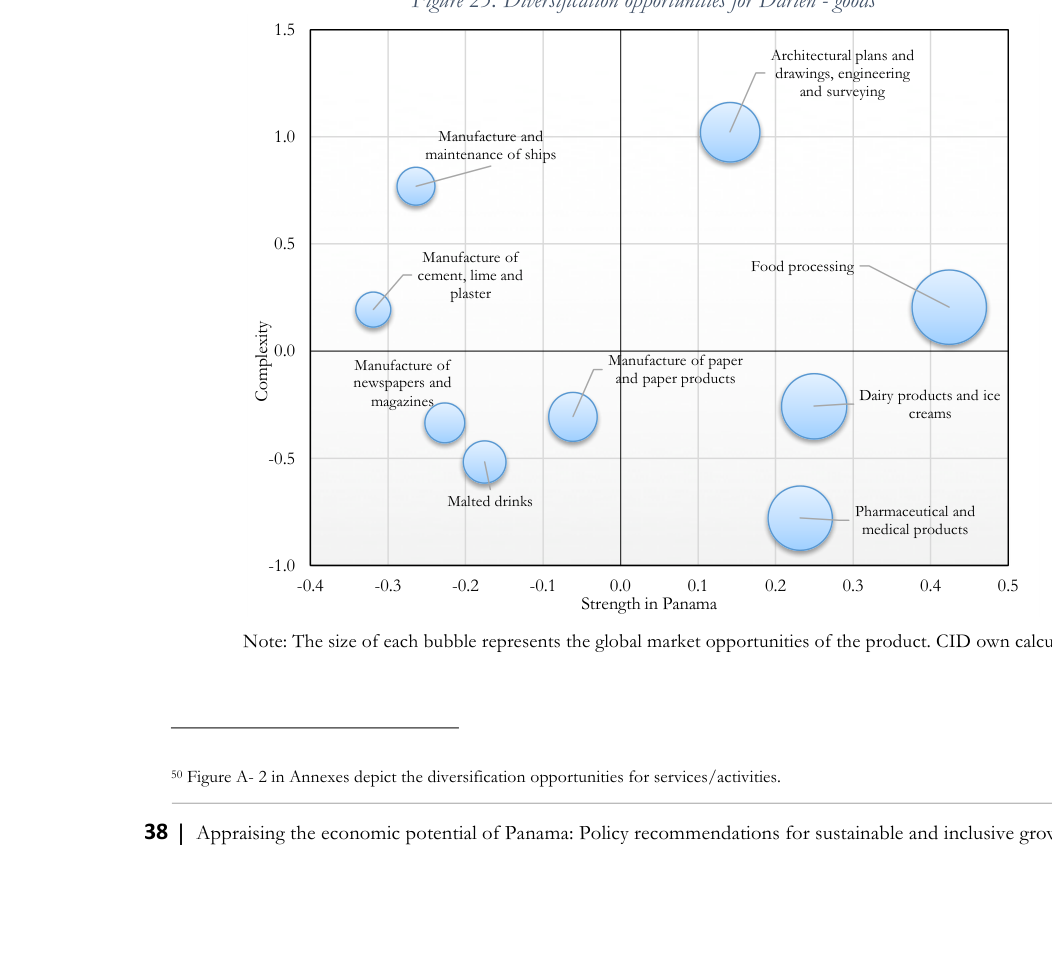
Note: The size of each bubble represents the global market opportunities of the product. CID own calculations.
38 | Appraising the economic potential of Panama: Policy recommendations for sustainable and inclusive growth.
The analyses presented in this section should be taken as illustrative examples to start a strategic conversation between the public and the private sector, to foster the productive diversification of the country’s provinces. The establishment of local investment agencies should serve not only as instruments to achieve this goal, but as a necessary condition to spur growth beyond the Panama-Colón axis. As we mentioned before, a successful industrial policy should not aim to pick the winner sectors but to get the policy process right.
Once the most attractive productive diversification opportunities have been screened out, a strategic, iterative and dynamic assessment of the factors preventing those sectors from achieving their potential should follow . That process might lead to identifying constraints that have not been signaled at a national level, but that are binding at the province level. Electricity emerges as an pertinent example. If Panama pursues aggressive diversification strategies in Chiriquí and Darién, and these involve energy-intensive manufacturing, power generation might soon become a constraint. Solving the constraint might be easier in Chiriquí – where a project aimed at expanding the interconnection line via Costa Rica is under way. Interconnecting Darién and Colombia might prove more difficult, as this project would face environment-related hurdles, and requires the approval of the indigenous communities located along the corridor. In those cases, increasing power via renewable or even clean energy might be more feasible.
39 | Appraising the economic potential of Panama: Policy recommendations for sustainable and inclusive growth.
6. References
Andrews, M., & Harrington, P. (2017). Learning to Target for Economic Diversification; PDIA in Sri Lanka (No. 332). Center for International Development at Harvard University.
Andrews, M., Pritchett, L., & Woolcock, M. (2013). Escaping capability traps through problem driven iterative adaptation (PDIA). World Development, 51, 234-244.
Araujo, J., Bruelner, M., Clavijo, M., Vostroknutova, E. And K. Wacker (2014). Benchmarking the determinants of economic growth in Latin America and the Caribbean. World Bank Report No. 91015-LAC.
CAF y Cámara de Comercio de Chiriquí (2014). Visión Chiriquí 2025.
http://www.camchi.org.pa/descargasrdn/VisionChq2025.pdf CAF y Ministerio de Seguridad Publica (2016). Plan Maestro Para El Desarrollo Integral Y Sostenible Del Distrito Del Barú 2040. http://www.zfb.gob.pa/documentos/plandesbaru/PMD_BAR%C3%9A_PlanyPresupuesto_j ulio2016.pdf Campante, F. and Sole ́ , A., (2015). Implementando Políticas de Desarrollo Productivo En Chiapas:
Marco Institucional. Harvard CID Faculty Working Paper No. 305.
Green, G. (1984). Getting to Know the General: The Story of an Involvement. New York, Pocket Books.
Hausmann, R., Espinoza, L., and Santos, M.A. (2017). “Shifting gears: A growth diagnostic of Panama”. Harvard Kennedy School Faculty Research Working Paper No. RWP 16-045, December 2016 (revised January 2017).
Hausmann, R., Morales, J.R. and Santos, M.A. (2017). “Panama beyond the Canal: Using Technological Proximities to Identify Opportunities for Productive Diversification”. Harvard Kennedy School Faculty Research Working Paper No. RWP 16-046, October 2016 (revised March 2017).
Hausmann, R., Morales, Santos, M.A. and Obach, J. (2017). “Special Economic Zones in Panama: A labor market perspective”. Harvard Kennedy School Faculty Research Working Paper No. RWP 16-326, October 2016 (revised May 2017).
Hausmann, R., and Rodrik, D. (2003). Economic development as self-discovery. Journal of development Economics, 72(2), 603-633.
Hausmann, R., Santos, M.A., Cheston, T., Pietrobelli, C. (2015). Towards a Prosperous and Productive Chiapas: Institutions, Policies, and Public-Private Dialog to Promote Inclusive Growth. Harvard CID Faculty Working Paper No. 317.
International Monetary Fund (2015). “Panama: 2015 Article IV Consultation”. IF Country Report No- 15/237. August.
Rodrik, D. (2004). Industrial policy for the twenty-first century.
40 | Appraising the economic potential of Panama: Policy recommendations for sustainable and inclusive growth.
Sigler, T. J. (2014). Panama’s special economic zones: balancing growth and development. Bulletin of Latin American Research, 33(1), pp. 1-15.
Stein, E., and Crespi, G. (Eds.). (2014). Rethinking Productive Development: Sound Policies and Institutions for Economic Transformation. Springer.
World Bank and Universidad Nacional de La Plata (2014). Informe de pueblos indígenas en América Latina.
World Bank, (2015). “Panama: Locking Success. A Systematic Country Diagnostic”.
41 | Appraising the economic potential of Panama: Policy recommendations for sustainable and inclusive growth.
7. Annexes
Figure A- 1: Diversification opportunities for Chiriquí – Services
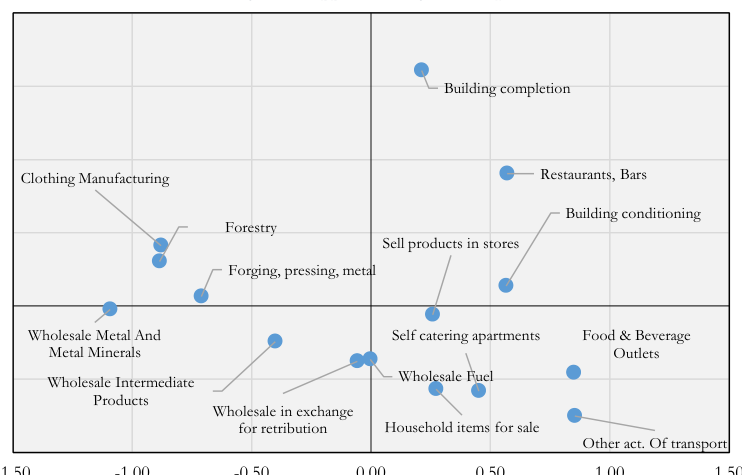
Figure A- 2: Diversification opportunities for Darién – Services
42 | Appraising the economic potential of Panama: Policy recommendations for sustainable and inclusive growth.
Figure A- 3: Diversification Opportunities – Province Recommendations 1. Bocas del Toro ran k industry sector employmen e 1 Repair and maintenance of transport equipment Manufacturing 43 0.98 2 Wholesale of machinery, equipment and material Retail and Wholesale 19 0.82 3 Repair of personal effects and household goods Retail and Wholesale 74 0.79 4 Building conditioning Construction 189 0.77 5 Activities of distribution of films, video and Retail and Wholesale 187 0.77 6 Construction of complete/parts of buildings Construction 1929 0.75
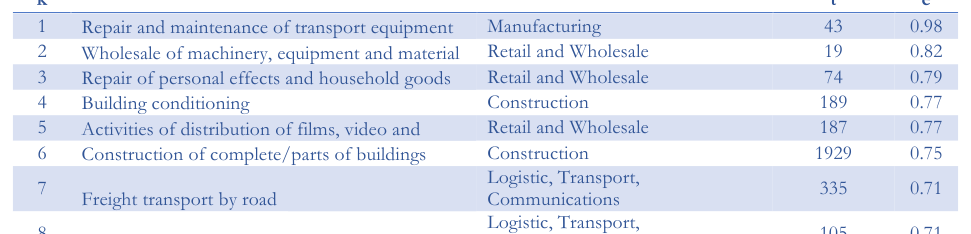
8 Telecommunications 9 Rental of construction or demolition equipment Construction 16 0.68 10 Architectural and engineering activities and activities FIRE and Business Services 54 0.67
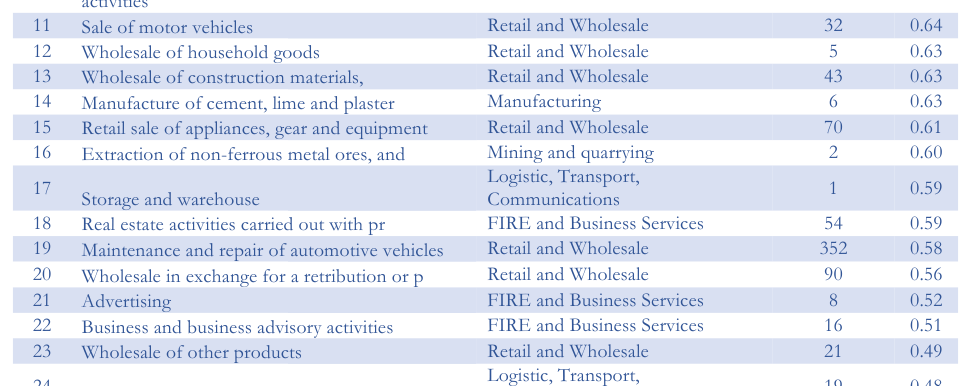
24 Regular transport by air

25 Extraction of stone, sand and clay Mining and quarrying 11 0.47 26 Elaboration of milk products, ice creams Manufacturing 26 0.43 43 | Appraising the economic potential of Panama: Policy recommendations for sustainable and inclusive growth.
scor t Logistic, Transport, Communications 105 0.71 Logistic, Transport, Communications 19 0.48
2. Coclé
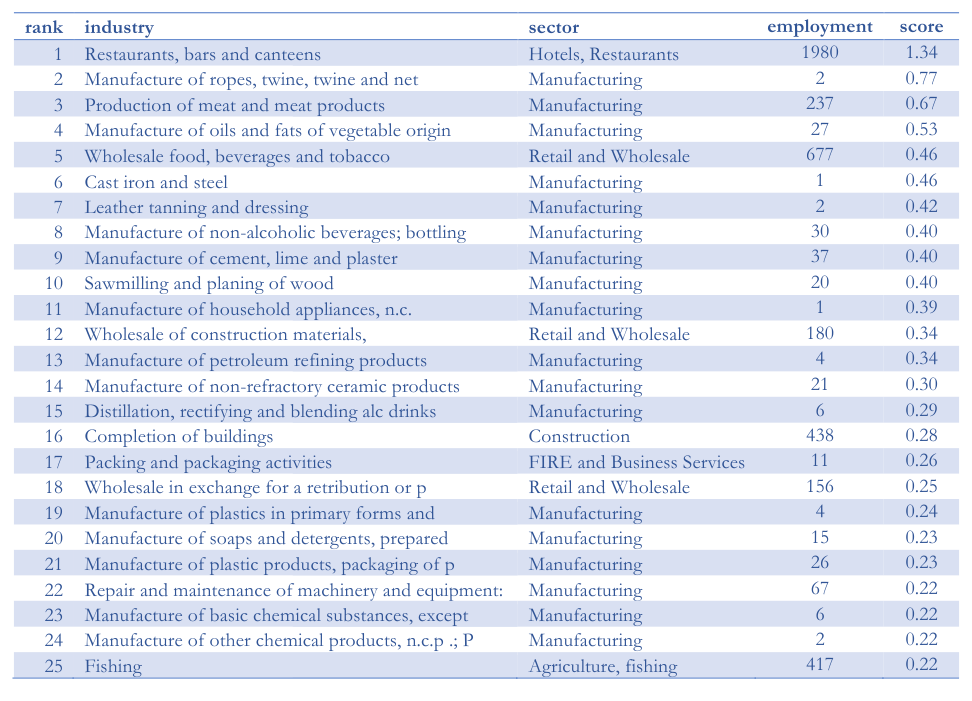
rank industry sector employment score 1 Restaurants, bars and canteens Hotels, Restaurants 1980 1.34 2 Manufacture of ropes, twine, twine and net Manufacturing 2 0.77 3 Production of meat and meat products Manufacturing 237 0.67 4 Manufacture of oils and fats of vegetable origin Manufacturing 27 0.53 5 Wholesale food, beverages and tobacco Retail and Wholesale 677 0.46 6 Cast iron and steel Manufacturing 1 0.46 7 Leather tanning and dressing Manufacturing 2 0.42 8 Manufacture of non-alcoholic beverages; bottling Manufacturing 30 0.40 9 Manufacture of cement, lime and plaster Manufacturing 37 0.40 10 Sawmilling and planing of wood Manufacturing 20 0.40 11 Manufacture of household appliances, n.c. Manufacturing 1 0.39 12 Wholesale of construction materials, Retail and Wholesale 180 0.34 13 Manufacture of petroleum refining products Manufacturing 4 0.34 14 Manufacture of non-refractory ceramic products Manufacturing 21 0.30 15 Distillation, rectifying and blending alc drinks Manufacturing 6 0.29 16 Completion of buildings Construction 438 0.28 17 Packing and packaging activities FIRE and Business Services 11 0.26 18 Wholesale in exchange for a retribution or p Retail and Wholesale 156 0.25 19 Manufacture of plastics in primary forms and Manufacturing 4 0.24 20 Manufacture of soaps and detergents, prepared Manufacturing 15 0.23 21 Manufacture of plastic products, packaging of p Manufacturing 26 0.23 22 Repair and maintenance of machinery and equipment: Manufacturing 67 0.22 23 Manufacture of basic chemical substances, except Manufacturing 6 0.22 24 Manufacture of other chemical products, n.c.p .; P Manufacturing 2 0.22 25 Fishing Agriculture, fishing 417 0.22 44 | Appraising the economic potential of Panama: Policy recommendations for sustainable and inclusive growth.
3. Colón

6 Repair and maintenance of machinery and equipment: Manufacturing 81 1.13

10 Manufacture of plastic products, packaging of p Manufacturing 36 1.03
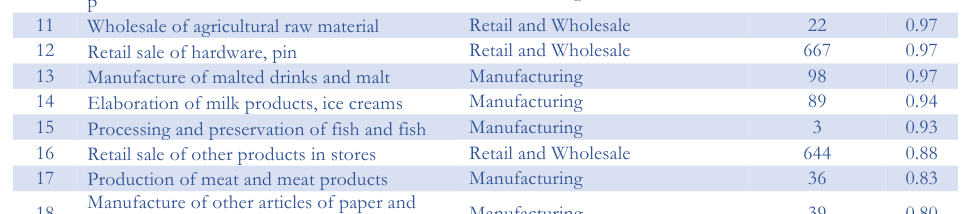
18 Manufacture of other articles of paper and paperboard Manufacturing 39 0.80 19 Elaboration of other food products, n.c.p Manufacturing 21 0.77 Logistic, Transport, Communications 428 0.77 20 Telecommunications 21 Retail Pharmaceutical Products and Me Retail and Wholesale 267 0.75 22 Publishing of magazines, magazines and pe publications Manufacturing 68 0.74 23 Manufacture of sugar Manufacturing 2 0.73 24 Manufacture of oils and fats of vegetable origin Manufacturing 11 0.73

28 Fabrication of concrete articles, plaster cement Manufacturing 134 0.68 29 Elaboration of milling products Manufacturing 16 0.65 30 Manufacture of non-alcoholic beverages; bottling Manufacturing 11 0.65 45 | Appraising the economic potential of Panama: Policy recommendations for sustainable and inclusive growth.
4. Chiriquí
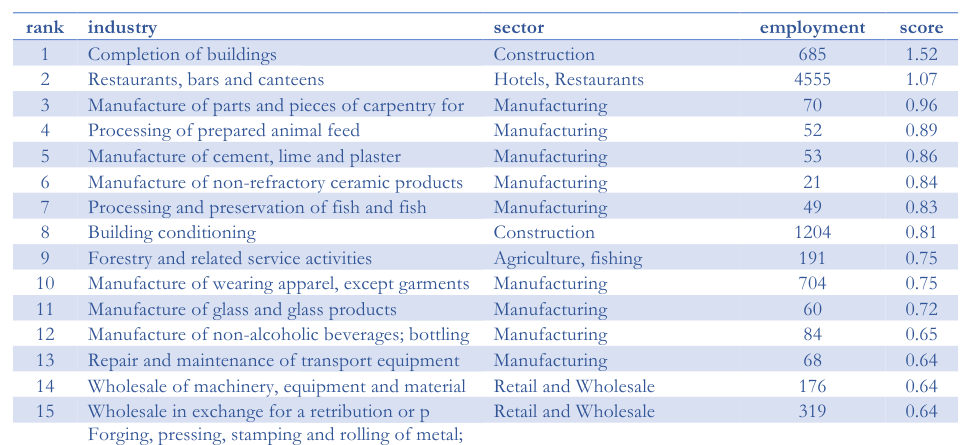
16 Forging, pressing, stamping and rolling of metal; Pu Manufacturing 10 0.63 17 Wholesale of other intermediate products, Retail and Wholesale 327 0.62 18 Retail sale of other products in stores Retail and Wholesale 1275 0.62 19 Manufacture of plastic products, packaging of p Manufacturing 151 0.60 20 Wholesale of metal and metal ores Retail and Wholesale 15 0.59 21 Extraction of non-ferrous metal ores, and Mining and quarrying 8 0.59 22 Wholesale solid fuel, liquid Retail and Wholesale 177 0.58 23 Manufacture of malted drinks and malt Manufacturing 116 0.55 24 Retail sale of appliances, gear and equipment Retail and Wholesale 652 0.55 25 Manufacture of basic chemical substances, except Manufacturing 12 0.52 26 Manufacture of primary iron and steel products Manufacturing 27 0.52
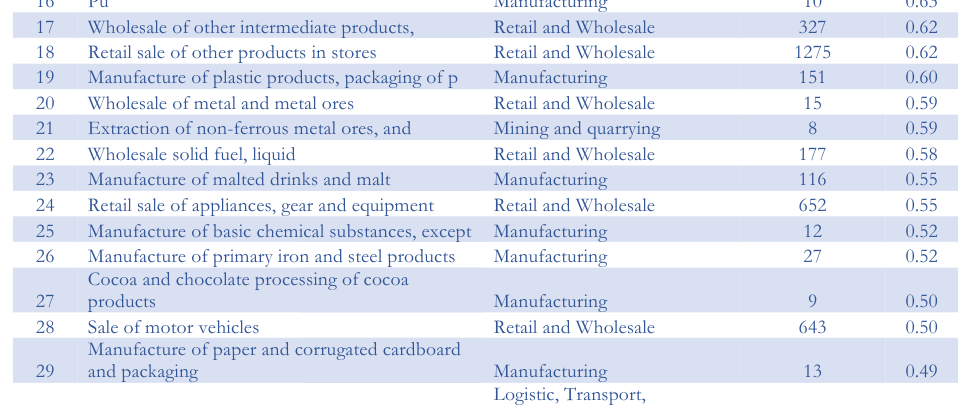
Logistic, Transport, Communications 113 0.49 30 Other complementary transport activities 46 | Appraising the economic potential of Panama: Policy recommendations for sustainable and inclusive growth.
5. Darién
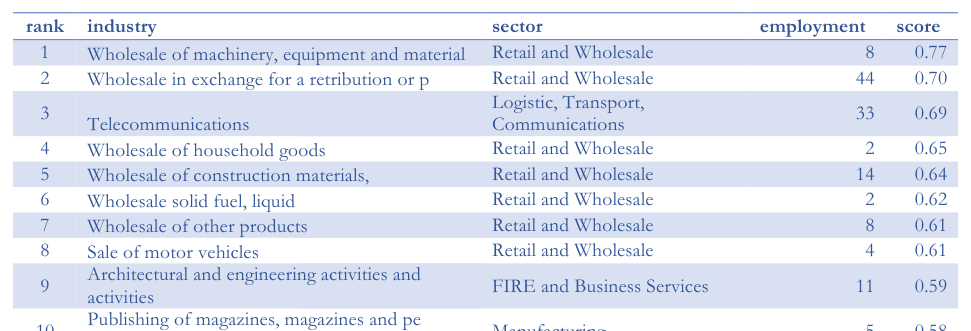
10 Publishing of magazines, magazines and pe publications Manufacturing 5 0.58

Logistic, Transport, Communications 1 0.55 14 Storage and warehouse

Logistic, Transport, Communications 14 0.51 18 Activities of travel agencies, organizers d
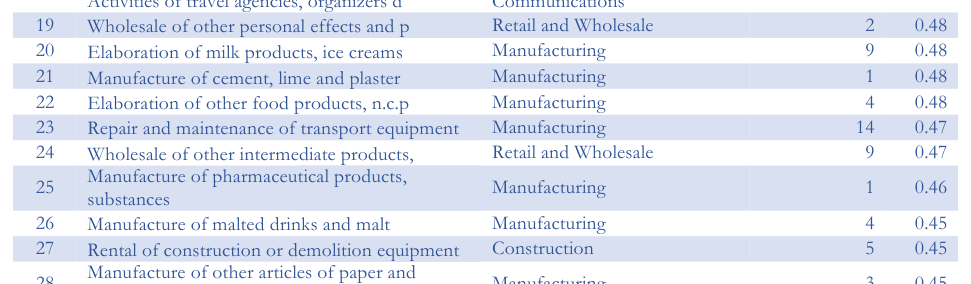
28 Manufacture of other articles of paper and paperboard Manufacturing 3 0.45 47 | Appraising the economic potential of Panama: Policy recommendations for sustainable and inclusive growth.
6. Herrera
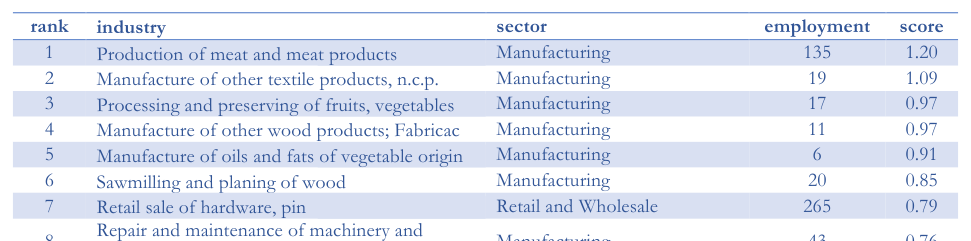
8 Repair and maintenance of machinery and equipment: Manufacturing 43 0.76
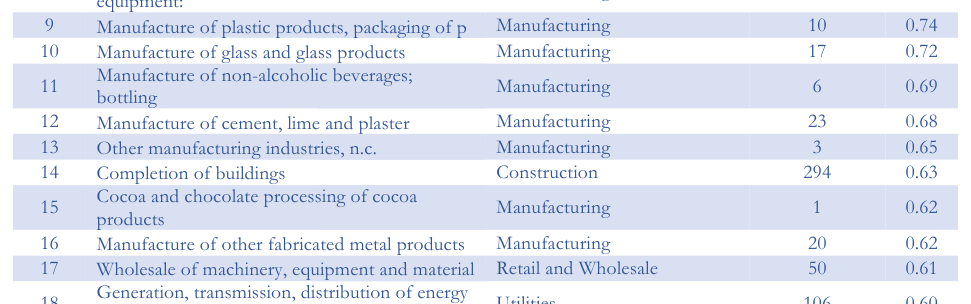
18 Generation, transmission, distribution of energy and Utilities 106 0.60 19 Wholesale solid fuel, liquid Retail and Wholesale 39 0.57 20 Manufacture of other articles of paper and paperboard Manufacturing 14 0.54 21 Wholesale of other personal effects and p Retail and Wholesale 9 0.54 22 Forging, pressing, stamping and rolling of metal; Pu Manufacturing 2 0.53
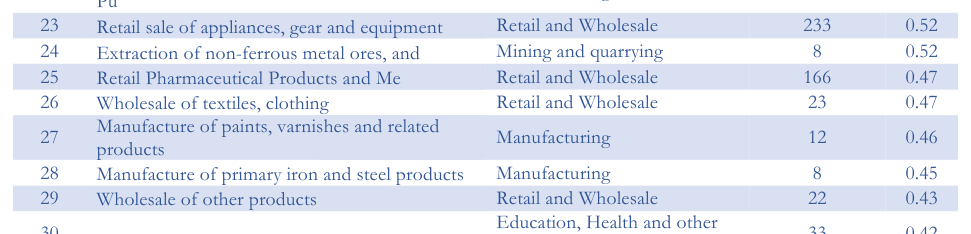
Education, Health and other social services 33 0.42 30 Disposal of waste and sewage, 48 | Appraising the economic potential of Panama: Policy recommendations for sustainable and inclusive growth.
7. Los Santos
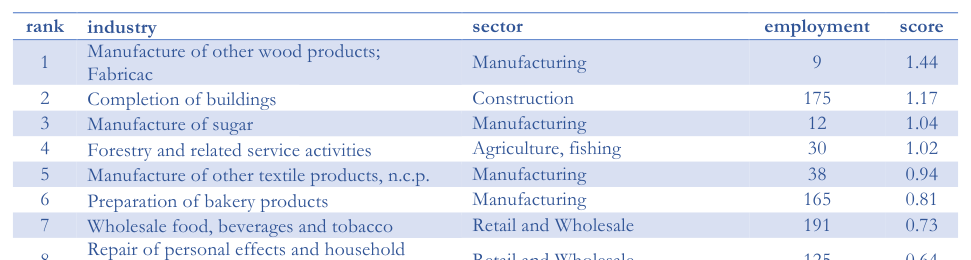
8 Repair of personal effects and household goods Retail and Wholesale 125 0.64

12 Repair and maintenance of machinery and equipment: Manufacturing 23 0.54
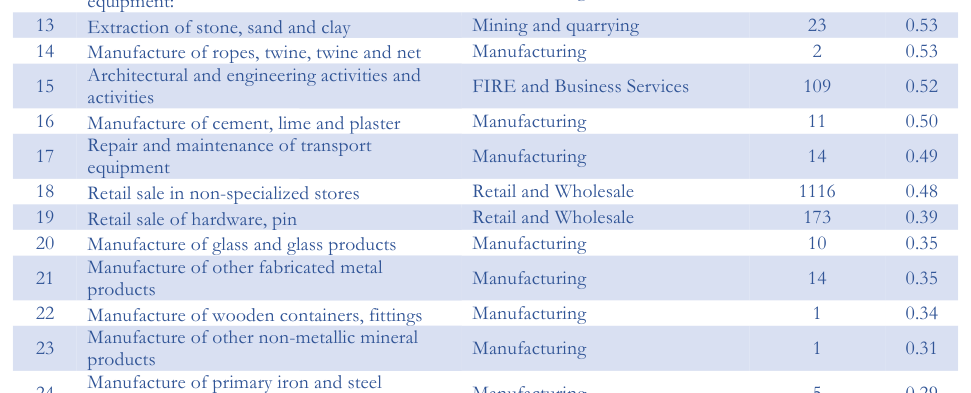
24 Manufacture of primary iron and steel products Manufacturing 5 0.29

28 Wholesale of machinery, equipment and material Retail and Wholesale 18 0.25 49 | Appraising the economic potential of Panama: Policy recommendations for sustainable and inclusive growth.
8. Panama (including West Panama).
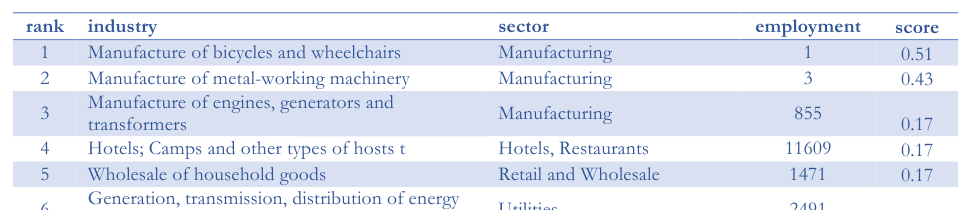
6 Generation, transmission, distribution of energy and Utilities 2491 0.16 7 Maintenance and repair of automotive vehicles Retail and Wholesale 14764 -0.03 8 Elaboration of tobacco products Manufacturing 25 -0.03 9 Wholesale in exchange for a retribution or p Retail and Wholesale 3098 -0.04 10 Wholesale of other personal effects and p Retail and Wholesale 967 -0.13 11 Collection, purification and distribution of water Utilities 1946 -0.14 12 Construction of civil engineering works Construction 6660 -0.14
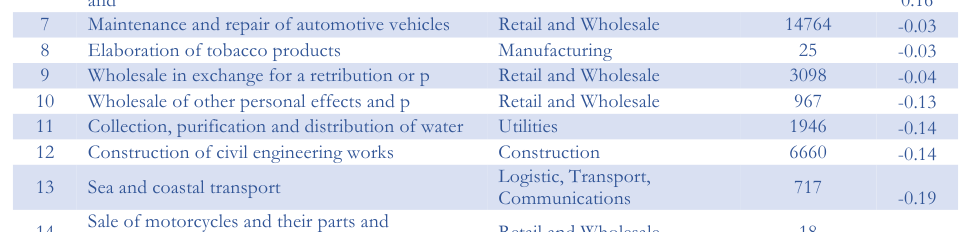
14 Sale of motorcycles and their parts and accessories Retail and Wholesale 18 -0.19 15 Wholesale of other intermediate products, Retail and Wholesale 1849 -0.23 16 Construction of complete buildings or parts of buildings Construction 63255 -0.28 17 Cutting, shaping and finishing of stone Manufacturing 27 -0.28 18 Wholesale of textiles, clothing Retail and Wholesale 2079 -0.31 19 Sale of parts and accessories of vehicles Retail and Wholesale 355 -0.33

20 Freight transport by road Logistic, Transport, Communications 9181 -0.34 21 Manufacture of refractory ceramic products, Manufacturing 25 -0.35 22 Retail sale of textiles, clothing Retail and Wholesale 14767 -0.37 23 Elaboration of milk products, ice creams Manufacturing 2527 -0.40 24 Retail sale of automotive fuel Retail and Wholesale 2385 -0.45 25 Retail sale in used goods stores Retail and Wholesale 473 -0.45

26 Handling of cargo Logistic, Transport, Communications 538 -0.45

30 Pipeline transportation Logistic, Transport, Communications 153 -0.55 50 | Appraising the economic potential of Panama: Policy recommendations for sustainable and inclusive growth.
9. Veraguas
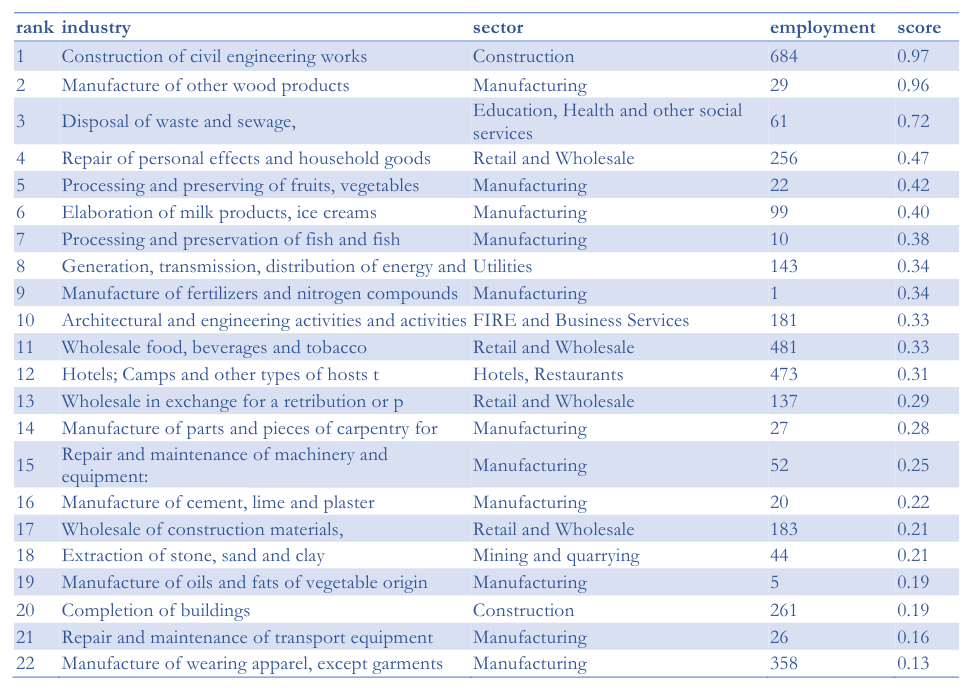
16 Manufacture of cement, lime and plaster Manufacturing 20 0.22 17 Wholesale of construction materials, Retail and Wholesale 183 0.21 18 Extraction of stone, sand and clay Mining and quarrying 44 0.21 19 Manufacture of oils and fats of vegetable origin Manufacturing 5 0.19 20 Completion of buildings Construction 261 0.19 21 Repair and maintenance of transport equipment Manufacturing 26 0.16 22 Manufacture of wearing apparel, except garments Manufacturing 358 0.13 51 | Appraising the economic potential of Panama: Policy recommendations for sustainable and inclusive growth.